Builders Risk Insurance for Coastal Construction Projects in the Carolinas
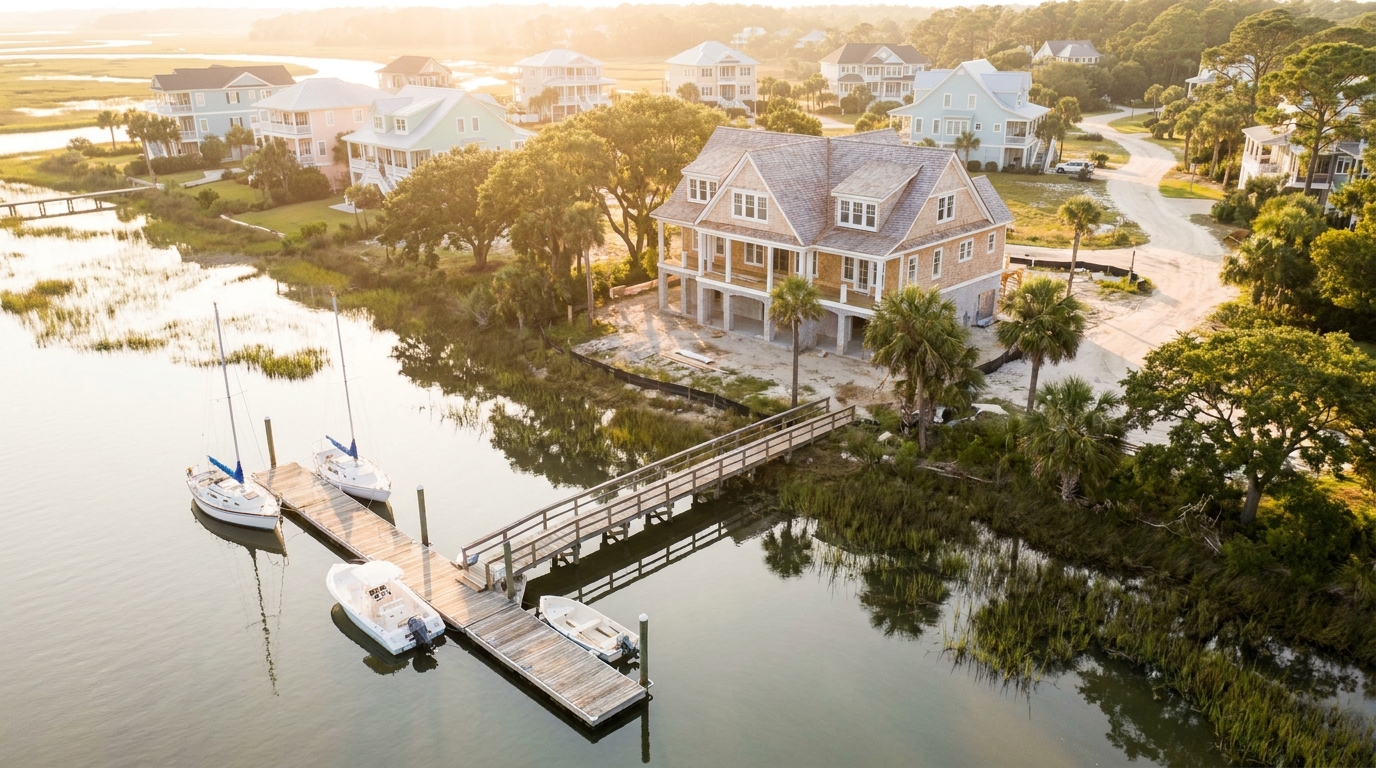
Builders risk insurance (also called course-of-construction coverage) protects the unfinished structure and many of the materials used to build it while work is underway, not after the project is complete and a permanent property policy takes over.[1] On coastal Carolina jobs from Myrtle Beach and Charleston through Wilmington and the Outer Banks, that temporary gap matters because fire, theft, wind, and weather losses can hit before occupancy, and flood is usually handled separately from a standard builders risk form.[1][2] Developers, general contractors, owners, and lenders with money tied up in the job all have a stake in getting the right form in place before materials land on site.
What builders risk (course of construction) actually covers
Builders risk is a first-party property policy written for the construction period. Industry guidance describes it as coverage for buildings that are under construction, with core protection that typically extends to installed materials and to materials stored on or off the project site.[1] In practical terms, that means the partially completed frame, the lumber stack, the HVAC units waiting to be set, and similar property that will become part of the finished building.
Policies differ by carrier, but common covered causes of loss on a well-written form include fire, theft, vandalism, wind, lightning, hail, certain water damage, explosions, and structural collapse.[1][2] Many forms are written on an open-perils (sometimes called all-risks) basis: they cover direct physical loss unless a cause is specifically excluded.[2] That structure is useful for coastal work, where weather and site security risks stack up over months of open framing and staged deliveries.
Additional pieces that often appear by endorsement or as sublimits include debris removal after a covered loss, materials in transit, temporary structures such as scaffolding or fencing, and soft costs that rise when a covered loss delays the schedule (extra interest, professional fees, or permit-related expenses).[1][2] Soft-cost limits are not automatic everywhere, so they should be called out when the loan agreement or development pro forma assumes a fixed delivery date.
What builders risk is not: it is not a substitute for general liability, workers compensation, or contractor equipment coverage. Trade sources note that most builders risk policies do not include liability protection for third-party bodily injury or property damage claims arising from the job site; those exposures sit on other policies.[1] Tools and equipment owned by the contractor, ordinary wear and tear, employee theft, design or workmanship defects, and mechanical breakdown are also commonly outside the builders risk form.[1][2]
Wind, flood, and the coastal Carolina gap
For builders risk insurance coastal Carolina projects, the hardest conversations are usually about wind and water, not about fire. Windstorm and hail are often included as covered perils on builders risk forms, but coastal underwriting can still attach percentage deductibles, named-storm terms, or separate wind arrangements that mirror how finished coastal properties are insured.[1][2]
In North Carolina, windstorm and hail coverage may be excluded from a primary property policy depending on location and underwriting guidelines. When that happens, a separate windstorm and hail policy is sometimes written through the North Carolina Insurance Underwriting Association (NCIUA), also known as the Coastal Property Insurance Pool, which was created to provide essential property insurance in Beach and Coastal Areas of the state.[3] Eligibility for an NCIUA windstorm and hail policy typically requires an active primary policy from an admitted carrier that has excluded windstorm.[3] Windstorm or hail deductibles may be stated as a percentage of Coverage A (dwelling or building limit); NC DOI uses the example of a 1% deductible on $200,000 of coverage equaling a $2,000 out-of-pocket amount on a wind or hail claim.[3]
In South Carolina, the South Carolina Wind and Hail Joint Underwriting Association (SCWHUA) is the residual property insurance market that provides coverage for the perils of wind and hail in designated coastal areas of the state.[4] That residual market exists because private capacity for pure wind exposure can tighten along the Grand Strand, Lowcountry barrier islands, and nearby coastal counties. Construction-period placements for SC jobs should be reviewed against the same coastal wind logic: is wind on the builders risk form, carved out, or arranged through a specialty or residual path, and what deductible applies when a named storm is in the forecast?
Flood is a different product family. FEMA is clear that most homeowners insurance does not cover flood damage and that flood insurance is a separate policy that can cover buildings, contents, or both.[5] The National Flood Insurance Program (NFIP) is managed by FEMA and delivered through participating private companies and NFIP Direct.[5] Homes and businesses in high-risk flood areas with mortgages from government-backed lenders are required to have flood insurance, and NFIP coverage is available in participating communities.[5] There is typically a 30-day waiting period before an NFIP policy goes into effect, with limited exceptions (for example, when coverage is required in connection with a government-backed loan or certain map changes).[5]
NFIP definitions also matter on active jobs. FloodSmart defines a "Building in the Course of Construction" as a walled and roofed building (with a General Rules exception for certain early stages) that is principally above ground and affixed to a permanent site. Critically, that definition does not include building materials or supplies intended for use in construction unless those materials are within an enclosed building on the premises.[6] Coastal High Hazard Areas (V, VE, and related V zones on Flood Insurance Rate Maps) are special flood hazard areas along the coast with additional hazards from wind-driven waves.[6] For a coastal Carolina build in or near an SFHA, that means flood coverage for the structure under construction and the treatment of staged materials should be confirmed in writing, not assumed from the builders risk binder alone.
Taken together: builders risk often addresses fire, theft, and many weather losses to the job; wind may need coastal-specific structuring; flood usually needs its own policy or endorsement path. Leaving either gap unexamined is how a storm season becomes a financing problem.
When developers and GCs need it on coastal builds
Anyone with a financial interest in the unfinished project should care about builders risk. Construction-industry writeups list owners, developers, general contractors, specialty contractors, architects, engineers, investors, and lenders among the parties who may need to be named or protected.[1][2] The construction contract usually decides who buys the policy. Sometimes the owner or developer purchases a project-specific form and adds the GC and major trades as additional insureds. Sometimes the GC buys the policy and lists the owner and lender. Either structure can work if limits, named insureds, and notice provisions match the loan and contract documents.
On coastal Carolina work, the need shows up at predictable milestones:
- Before ground-breaking or foundation work. Permanent construction (slabs, piles, columns, framing) begins accumulating value the moment it leaves the ground. Lenders commonly require evidence of course-of-construction coverage before the first draw.
- When materials start staging on site. Open lumber, appliances, windows, and copper are attractive theft targets. Theft and vandalism are core builders risk perils on standard educational summaries of the product.[1][2]
- Across the Atlantic hurricane season. The National Hurricane Center states that hurricane season in the Atlantic begins June 1 and ends November 30.[7] Many Carolina commercial and multi-family schedules span that window, which means open framing and incomplete envelopes can sit through the peak months of the year.
- On renovations and vertical expansions, not only ground-up shells. Course-of-construction coverage also applies when substantial improvements or additions create a temporary property risk that a finished homeowners or commercial property form was not designed to carry alone.[1]
- Whenever the project sits in or near a mapped flood zone, barrier island corridor, or area with private wind restrictions. High-risk flood zones with federally related financing bring mandatory flood purchase rules; coastal wind markets in both Carolinas have residual-market backstops when admitted markets exclude wind.[3][4][5]
A 2023 Insurance Journal summary of Insurance Information Institute research linked higher hurricane claim costs to continued coastal construction and rising property values and replacement costs, and it noted that coastal northern Florida, Georgia, and the Carolinas were among U.S. areas with the greatest dollar growth in NFIP claim payouts over the prior two decades. The same piece cited Census-based population growth of 11.3% in South Carolina and 10.3% in North Carolina between 2011 and 2020 among the fastest-growing states in that period.[8] Those are industry and demographic context points, not a forecast for any single job, but they explain why lenders and carriers look hard at coastal Carolina construction schedules and limits.
How coverage is usually structured (limits, term, and named insureds)
Builders risk can be written as a single-project policy or, for active builders, as a reporting or blanket form that picks up jobs as they start. Limit setting usually starts with the completed construction value (hard costs), then layers materials, soft costs if purchased, and any existing structure if the job is a renovation. Land value is not what you are insuring; the insurable interest is the work and materials that can burn, blow away, flood, or be stolen.
Term should track the real schedule, with a clear process for extensions if weather, inspections, or supply delays push the certificate of occupancy. Coastal projects that start in spring and finish after peak hurricane season need that extension conversation early. Cancellation and occupancy triggers also matter: many forms end or convert when the building is occupied, put to its intended use, or accepted by the owner, so a partial turnover can create a coverage cliff if permanent property insurance is not ready.
Named insureds and additional insureds should match the parties with skin in the game. Lenders often require mortgagee or loss-payable language. Subcontractors with significant material exposure may need to be scheduled or covered under installation floater language so their staged product is not left in a gray zone between the GC's builders risk and their own inland marine forms.[1]
Finally, read the flood and earth-movement exclusions on the actual form. Open-perils builders risk still commonly excludes flood and earthquake unless those perils are bought back or placed elsewhere.[2] On the Grand Strand or Lowcountry, "elsewhere" often means an NFIP policy, a private flood form, or a carefully structured endorsement, plus clear documentation of base flood elevation, foundation type, and temporary protection measures for materials.
Practical steps for a coastal Carolina job
- Pull the construction contract and loan insurance requirements before the first materials order. Note who must purchase builders risk, minimum limits, additional insured wording, and any flood or wind conditions.
- Confirm the FEMA flood zone and community participation status for the parcel, and decide early whether NFIP, private flood, or both will sit beside the builders risk policy.[5][6]
- Ask how wind and hail are treated on the specific form for that ZIP code and construction type, including percentage or named-storm deductibles and any residual-market path in NC or SC coastal territories.[3][4]
- Inventory staged materials, off-site storage, and in-transit exposures. If materials sit outside an enclosed building, remember that NFIP's course-of-construction definition generally does not treat those loose supplies as part of the insured building unless they are within an enclosed building on the premises.[6]
- Align soft-cost and delay coverage with the pro forma if a covered loss would create interest carry, liquidated damages, or redesign fees.[1][2]
- Schedule the transition to permanent property, liability, and (where needed) wind and flood policies before occupancy or beneficial use, so the project does not go bare for a weekend between forms.
- Keep site security and temporary weather protection in the risk plan. Insurance responds after a covered loss; fencing, lighting, securing openings before a tropical system, and elevating materials reduce claim frequency and severity regardless of the form.
Practical takeaways
- Builders risk (course-of-construction) coverage protects the unfinished building and many construction materials during the job; it is temporary property insurance, not liability insurance.[1][2]
- Fire, theft, vandalism, wind, and hail are commonly addressed on builders risk forms, but exact terms, deductibles, and soft-cost options vary by carrier and must be read on the policy.[1][2]
- Flood is usually separate. FEMA states most homeowners insurance excludes flood, NFIP is a distinct program, high-risk properties with government-backed mortgages face mandatory purchase rules, and a typical NFIP waiting period is 30 days.[5]
- NFIP's course-of-construction definition focuses on a walled and roofed building and generally does not treat loose construction materials as covered building property unless they are inside an enclosed building on the premises.[6]
- Coastal NC and SC markets may rely on residual wind facilities (NCIUA / Coastal Property Insurance Pool in North Carolina; SCWHUA in South Carolina) when private policies exclude wind and hail.[3][4]
- Atlantic hurricane season runs from June 1 through November 30, so multi-month coastal schedules should assume tropical weather risk during open construction.[7]
- Owners, GCs, developers, and lenders should all verify they are named correctly and that limits track completed values before materials arrive on a coastal Carolina site.[1][2]
How we can help
At Beach Insurance LLC, our team works with coastal developers, general contractors, and property owners who need course-of-construction coverage that fits Carolina wind and flood realities, not a one-size inland form. We help review contract and lender requirements, compare builders risk options, and coordinate related commercial placements so wind, flood, and permanent property coverage do not leave a gap when the certificate of occupancy arrives. If you are planning or already bidding a coastal build, start with our builders insurance page or request a commercial quote, or call us at (843) 626-9244.
Citations
- Procore, "A Contractor's Guide to Builder's Risk Insurance" (2024)
- NerdWallet, "Builder's Risk Insurance: How It Works, Where to Get It" (2026-02-20)
- North Carolina Department of Insurance, "Windstorm and Hail" (accessed 2026)
- South Carolina Department of Insurance, "Useful Links" (SC Wind and Hail Joint Underwriting Association description) (accessed 2026)
- FEMA, "Flood Insurance" (2026-01-02)
- National Flood Insurance Program / FloodSmart, "Glossary" (Building in the Course of Construction; Coastal High Hazard Areas) (accessed 2026)
- National Hurricane Center (NOAA), "Hurricane Season Dates" (Atlantic season June 1 to November 30) (accessed 2026)
- Insurance Journal, "Coastal Construction, Rising Replacement Values Contribute to Costly Hurricane Claims" (2023-07-21)