Commercial Auto Insurance for Service Fleets and Work Vehicles
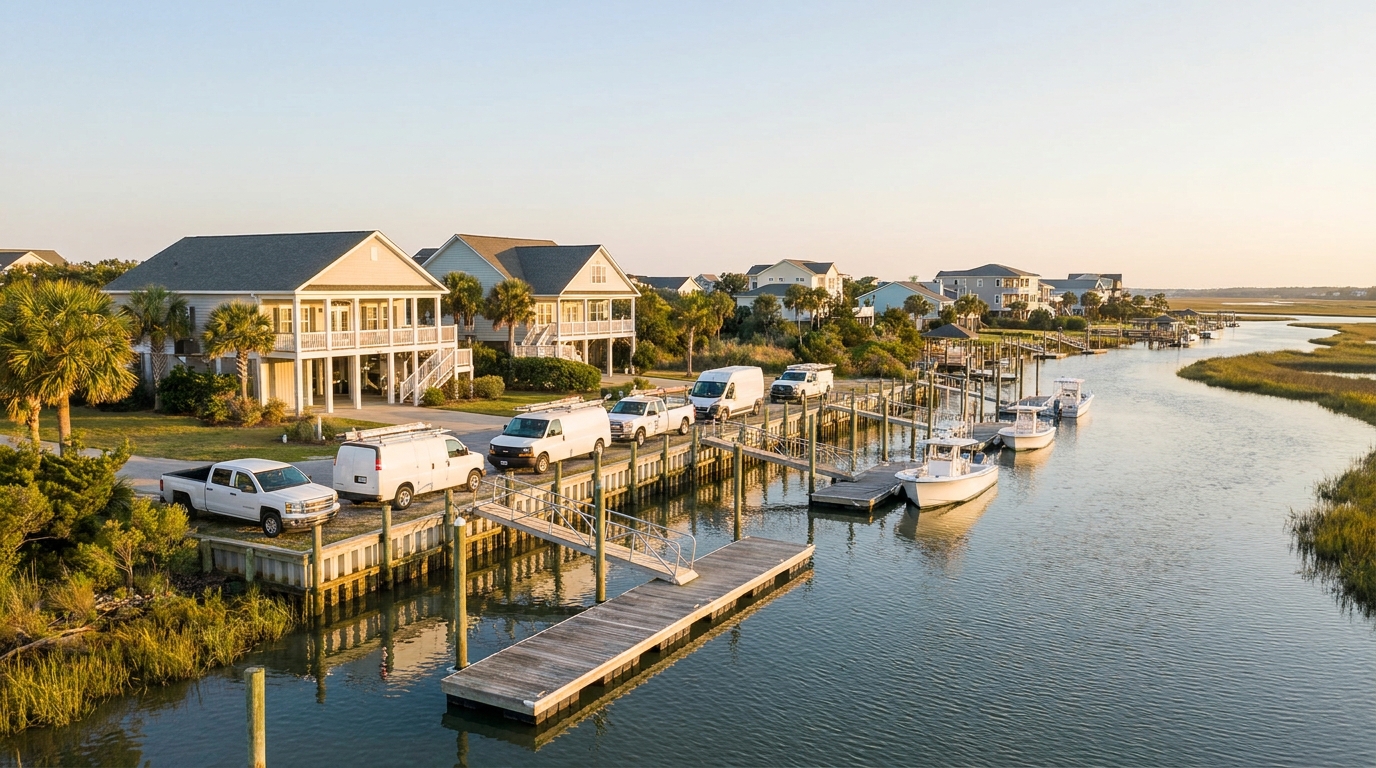
Commercial auto insurance for a service fleet or work vehicles is a business auto policy that covers liability, and often physical damage, when company vehicles (or certain hired and non-owned vehicles) are used for work. Personal auto policies frequently exclude or limit business-related liability, so owner-operators and small fleets that rely only on personal coverage can face a claim denial after a job-site or customer-call accident.[3][6] In South Carolina and North Carolina, state minimum liability limits are only a floor for registration and legal driving. They are rarely enough for a business with tools, crew, and customer property on the road.
Why service fleets need a commercial auto policy
If you run HVAC, plumbing, electrical, landscaping, delivery, cleaning, or general contracting along the Grand Strand, Charleston, or into coastal North Carolina, your vehicles are part of the job. A work truck is not only transportation. It is a mobile warehouse for tools, ladders, compressors, and materials. That mix of liability to other drivers, damage to the vehicle, and exposure when employees drive for you is exactly what a business auto policy is built to address.
State regulators describe commercial auto as similar in structure to personal auto, but more complex because business use creates specialty exposures. A Business Auto Policy (BAP) can be scheduled vehicle by vehicle and can include owned, hired, and non-owned autos depending on the coverages you buy.[4] Commercial policies also commonly use a combined single limit (CSL) for liability, often at levels such as $500,000 or $1,000,000, rather than the smaller split limits common on personal policies.[4]
For many small businesses, the practical question is not “Do I need insurance?” It is “Is the insurance I already pay for actually designed for work use?” Maryland’s consumer commercial insurance guide, which walks business owners through the same commercial-versus-personal choice, notes that commercial policies typically carry higher liability limits (for example, about $1 million) and may include provisions for rented and employee-owned vehicles used for company business.[3] That framing matches what we see with service fleets in SC and NC: the vehicles look ordinary, but the use is commercial.
Personal policies and business use: the common gap
A frequent problem for owner-operators and first-time fleet owners is assuming a personal auto policy will respond the same way at a customer’s driveway as it does on a Saturday errand. It often does not.
Maryland’s business owners guide is direct: if you are relying on a personal auto or personal umbrella policy for company use of vehicles, review the policy language carefully, because many personal insurance policies exclude business-related liability claims.[3] Progressive Commercial’s hired and non-owned overview makes the same point from the carrier side: personal auto policies usually exclude business use, and if an employee is in an accident while driving for work, the personal policy may not cover it and the business can still be held liable.[6]
That does not mean every personal policy rejects every business-related claim in every situation. Policy forms differ by insurer, and some allow limited business use of a private passenger vehicle. The risk is that “I drive to job sites” or “my tech uses her car for supply runs” is not something you want to discover after a claim. Title the vehicle in the business name, hang ladder racks and magnetic logos, keep a schedule of employees who drive, and you are describing a commercial exposure. That is when a commercial vehicle insurance conversation with an independent agent is the safer path.
Factors that usually push you toward a commercial policy include:
- The business (not you personally) owns or leases the vehicle.
- Employees or helpers drive for work.
- The vehicle hauls tools, materials, or customer goods as part of daily operations.
- You advertise the vehicle with company branding or use it for deliveries.
- A lender, client contract, or general contractor requires proof of commercial auto liability.
Liability coverage: the foundation for work vehicles
Liability is the coverage that responds when you (or a covered driver) are responsible for bodily injury or property damage to others. South Carolina’s Department of Insurance explains that SC drivers must carry minimum liability of $25,000 per person and $50,000 per accident for bodily injury, plus $25,000 for property damage, along with uninsured motorist coverage at the same 25/50/25 floor (typically with a $200 uninsured property-damage deductible).[1] Those figures are statutory minimums for legal operation. They are not a recommendation for a service business that can face multi-vehicle claims, medical bills, and damage to a customer’s home or another contractor’s truck.
North Carolina requires continuous liability insurance on registered vehicles and has raised its minimum limits for policies issued or renewed on or after July 1, 2025. Under NCDMV guidance, those newer policies must meet at least $50,000 bodily injury per person, $100,000 per accident, and $50,000 property damage (up from the prior 30/60/25 structure for older policies).[2] The North Carolina Department of Insurance described the same July 1, 2025 increase for new and renewed policies.[7] Even with the higher NC floor, many commercial clients and construction contracts still request $1 million CSL liability, which is common on business auto placements.[3][4]
For service fleets, liability limits should reflect:
- How many vehicles are on the road at once
- Whether employees drive alone or as a crew
- The value of property and people you regularly share the road with
- Contract requirements from GCs, property managers, or municipalities
- Whether you want an umbrella or excess liability layer above the auto policy
We do not invent premium quotes or carrier-specific prices in this article. Limits and cost depend on garaging ZIP codes, driving records, vehicle type, radius of operations, and claims history. The right process is a full application reviewed against multiple markets, not a one-size minimum.
Physical damage: collision, comprehensive, and work equipment
Physical damage coverage protects the vehicle itself. South Carolina DOI describes collision as paying for damage from colliding with another object, and comprehensive as covering many other causes such as fire, vandalism, flood, theft, falling objects, and animal strikes.[1] Lenders often require both comprehensive and collision when money is still owed on the truck or van.[3]
Service fleets should also talk through:
- Deductibles you can actually afford if several vehicles are damaged in a coastal storm
- Actual cash value settlement language on older work vans
- Permanently attached equipment such as ladder racks, tool boxes, generators, or liftgates (Maryland’s guide specifically suggests increasing coverage for permanently attached items)[3]
- Tools and cargo that may need inland marine or tools-and-equipment coverage rather than auto physical damage alone
A bare liability-only policy may keep the plate legal and meet a state minimum, but it will not replace a wrecked box van that is the backbone of a two-person crew.
Hired and non-owned auto (HNOA): the coverage small fleets forget
Many service businesses own some vehicles and still create liability with vehicles they do not own. That is the hired and non-owned auto (HNOA) problem.
Hired auto applies when the business rents, leases, or borrows a vehicle for work, such as a cargo van for a one-day move or a rental car on a multi-day service trip.[5][6][8]
Non-owned auto applies when employees, partners, or others use personal vehicles for business activities, such as a tech driving a personal car to a client meeting or running parts between jobs.[5][6][8]
Travelers notes that commercial auto policies do not automatically cover vehicles you do not own, even when used for business, which is why HNOA may be needed.[5] Progressive Commercial states that standard commercial auto generally covers vehicles the company owns, while HNOA protects the business for hired, leased, borrowed, or employee personal vehicles used for work.[6] The Big “I” Virtual University resource for independent agents emphasizes that non-owned coverage protects the employer and is typically secondary to the employee’s personal policy, which may deny or limit a claim when the vehicle was used for commercial activity.[8]
Important HNOA realities for service fleets:
- HNOA is primarily liability protection for the business. It usually does not fix physical damage to the employee’s car or the rental unit unless you add separate physical damage solutions.[6][8]
- It is not a substitute for workers’ compensation if an employee is injured.[6]
- It does not turn personal commuting into a commercial claim when the trip is not business use.[6]
- Many agents treat HNOA as a best-practice add-on for commercial clients who ever use rentals or employee cars.[8]
If your team still makes bank deposits, picks up parts, or runs errands in personal vehicles, HNOA belongs in the conversation even when most work is done in company trucks.
When federal financial-responsibility rules enter the picture
Most local service fleets (plumbers, electricians, lawn care) are not for-hire interstate motor carriers. Some businesses, however, grow into heavier trucks, for-hire hauling, or specialized cargo. Federal rules under 49 CFR Part 387 set minimum levels of financial responsibility for certain motor carriers. For for-hire carriage of nonhazardous property in interstate or foreign commerce with a gross vehicle weight rating of 10,001 pounds or more, the scheduled public liability minimum is $750,000. Higher limits apply for certain hazardous materials and other commodity categories.[9]
That federal schedule is a specialized compliance topic, not a default limit for every service van in Myrtle Beach. If you operate heavier commercial motor vehicles, for-hire loads, or hazmat, you need a deliberate compliance review, not only a local commercial auto quote. For everyone else, the takeaway is simpler: legal minimums (state or federal) are not the same thing as adequate protection for the business you actually run.
SC and NC service fleets: practical local notes
Coastal and near-coastal operations add operational detail that pure inland fleets do not always face:
- Storm exposure can pile comprehensive claims across a fleet after one weather event. Deductible strategy matters.
- Tourist-season traffic in Myrtle Beach and Charleston increases accident frequency for vehicles that run all day between service calls.
- Cross-border work between South Carolina and North Carolina means you should keep both states’ liability floors and continuous-coverage rules in mind, especially if vehicles are registered in one state and work regularly in the other.[1][2]
- Client certificates often demand additional insured wording, primary and noncontributory language, or specific liability limits. A personal policy rarely satisfies those requests cleanly.
South Carolina requires uninsured motorist coverage at the liability minimum and requires insurers to offer underinsured motorist coverage (purchase is optional for the consumer).[1] North Carolina also requires uninsured and underinsured motorist elements tied to its liability structure.[2] For a fleet, we still focus first on liability limits and driver controls, then on UM/UIM, physical damage, and HNOA.
Building a workable fleet program (not just a policy)
Insurance works better when the operation is organized. Carriers underwrite the people and the practices as much as the VINs.
Useful steps for small fleets and owner-operators:
- List every vehicle and how it is used (service radius, towing, overnight take-home, advertising wraps).
- Name drivers and pull motor vehicle records on a schedule. Travelers’ HNOA guidance includes vetting drivers, checking licenses, and reviewing MVRs annually as part of reducing business-related accidents.[5]
- Write simple driving rules (no handheld phone use, no unauthorized personal use of company trucks, incident reporting within 24 hours).
- Separate personal and business use for owners who also keep a family car. Mixed use without disclosure is a claims headache.
- Match the named insured to the legal entity that owns the vehicles and signs contracts.[3]
- Review certificates before bid season so limits and endorsements match what GCs require.
- Revisit HNOA whenever you add temporary labor, rentals, or employee personal-vehicle errands.
A commercial auto insurance service fleet program is not a single form. It is liability limits, physical damage decisions, hired/non-owned options, and operating rules that fit how you actually dispatch work.
Practical takeaways
- State minimum liability in SC (25/50/25 plus required UM) and NC (higher 50/100/50 structure for policies issued or renewed on or after July 1, 2025) is a legal floor, not a fleet adequacy standard.[1][2][7]
- Many personal auto policies exclude or limit business-related liability, so work vans, employee drivers, and logo’d service trucks usually belong on a commercial policy.[3][6]
- A Business Auto Policy can schedule owned vehicles and, with the right symbols and endorsements, address hired and non-owned exposures.[4][5]
- HNOA is liability protection for rentals and employee personal cars used for business. It is usually not physical damage coverage for those vehicles.[6][8]
- If you grow into for-hire operations with heavier vehicles, federal Part 387 financial-responsibility minimums (for example, $750,000 for certain nonhazardous for-hire property carriers at GVWR of 10,001 pounds or more) may apply.[9]
- Driver screening, vehicle schedules, and clear use rules support both safety and insurability.[3][5]
- Tools, cargo, and permanently attached equipment may need more than basic auto physical damage.[3]
How we can help
Beach Insurance LLC is an independent agency serving Myrtle Beach, Charleston, Charlotte, and coastal North and South Carolina. Our team helps owner-operators and small fleets compare commercial auto options across multiple carriers, including liability limits, physical damage, hired and non-owned auto, and how the policy fits your contracts. If you want a clear review of your current setup, start with our commercial vehicle insurance page or request a commercial quote so we can map coverage to how your vehicles actually work.
Citations
- South Carolina Department of Insurance, "Automobile Insurance" (accessed 2026)
- N.C. Division of Motor Vehicles, "Vehicle Insurance Requirements" (updated 2026-07-29)
- Maryland Insurance Administration, "A Business Owners Guide to Commercial Insurance" (commercial auto section)
- California Department of Insurance, "Commercial Insurance Guide" (Form 700, revised 2024-06-14), Commercial Automobile section
- Travelers, "Hired and Non-Owned Auto Coverages (HNOA)"
- Progressive Commercial, "What Is Hired and Non-Owned Auto Insurance?"
- North Carolina Department of Insurance, "Changes to the Rating of Automobile Insurance Policies, Effective July 1, 2025"
- Independent Insurance Agents & Brokers of America / Big "I" Virtual University, "Navigating Commercial Auto Insurance: Understanding Hired, Non-Owned, and Drive Other Car Coverages" (2026-01-08)
- eCFR / FMCSA, "49 CFR § 387.9 Financial responsibility, minimum levels"