RV Insurance Carolina Travelers Need a Separate Policy
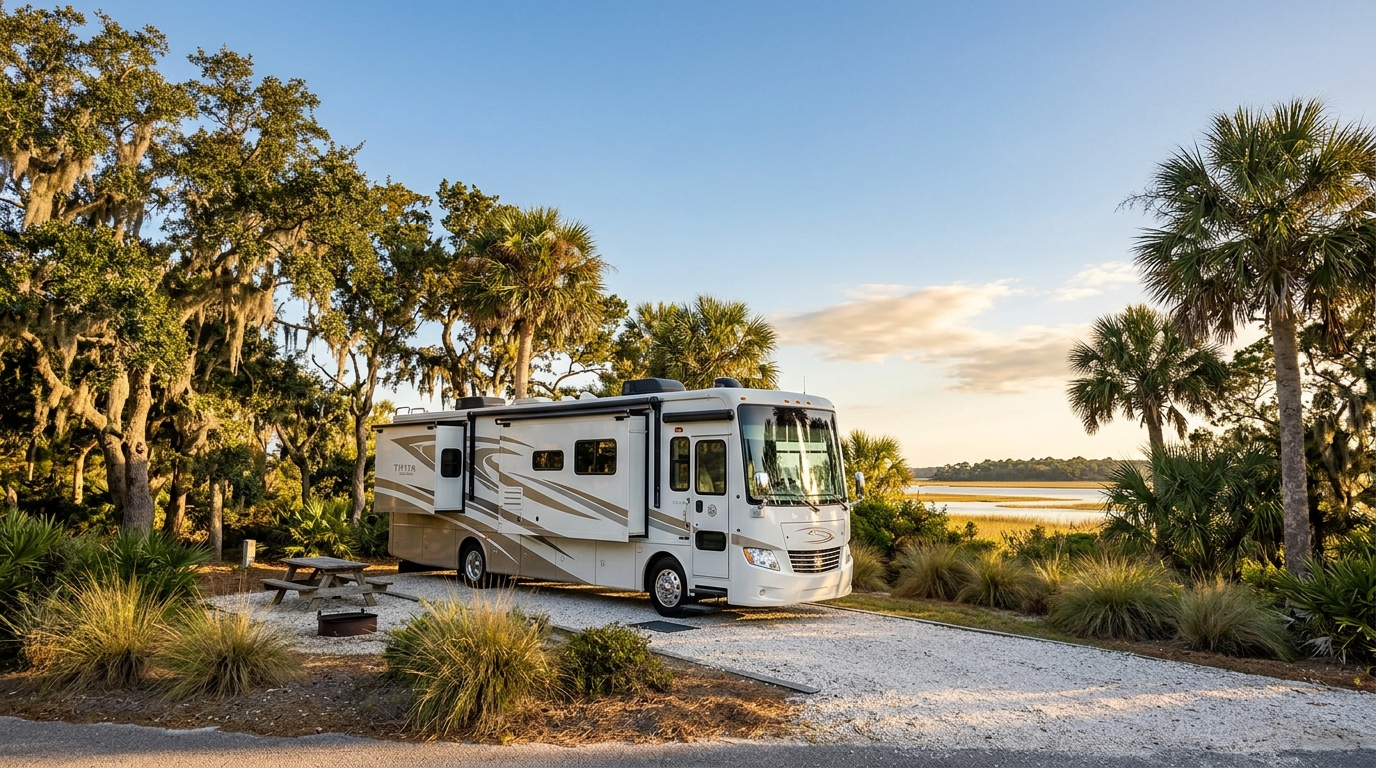
RV insurance Carolina travelers actually need is usually its own product, not a free add-on hanging off a car or house policy. A motorhome (Class A, B, or C) is a vehicle you drive, so it needs liability, and often collision and comprehensive, written for that unit. A travel trailer or fifth wheel is towable. Your auto policy may help with liability while you are towing, but damage to the trailer itself usually takes a separate RV policy or endorsement. [1][2][3]
A standard homeowners policy is built around a house: the structure, belongings, and liability at that property. [4] Some personal property coverage can follow you on the road, but the limits are often modest, and parked-rig liability is not the same as driveway liability. [1][5] If you live in the RV full time, or spend entire winters on the Carolina coast as a snowbird, tell your agent. Full-timers coverage is designed for personal property and for liability when you are not driving, such as a guest injured inside the coach. [1]
Practical takeaways
- Name the unit correctly. Motorhomes and towable trailers are insured differently. [1][3]
- Do not assume your personal auto policy covers an RV. The National Association of Insurance Commissioners (NAIC) says a standard auto policy does not cover recreational vehicles. [2]
- Keep liability in force on any motorhome registered in North Carolina or South Carolina. North Carolina requires continuous liability from a company licensed in the state. South Carolina requires liability and uninsured motorist coverage at 25/50/25. [6][7]
- Ask what pays if someone is hurt while the rig is parked at a campground, not while it is rolling. [1]
- Inventory what you keep inside. Homeowners off-premises coverage and RV contents limits are not interchangeable. [1][5][8]
- Say whether use is weekend, seasonal snowbird, or full-time. That changes the coverage conversation. [1]
- If you finance the motorhome, ask about the gap between the loan balance and actual cash value. [9]
- Travel insurance for a cancelled airline trip is a different product from RV insurance. See our travel insurance page if you need trip protection.
Motorhomes and towables are not the same risk
Go RVing, the industry consumer site, groups recreational vehicles into towable units and driveable units. Towables include conventional travel trailers (often about 20 to 35 feet) and fifth wheels (often about 21 to 40 feet). Driveable motorhomes are Class A coaches (about 21 to 43 feet), Class B camper vans (about 16 to 21 feet), and Class C coaches (about 25 to 35 feet). [3]
That split matters for insurance.
Texas Department of Insurance consumer guidance is useful in the Carolinas because it explains how the products are built, not a carrier's price list. Travel trailers and fifth wheels are pulled by a truck. Your auto insurance might pay for accidents you cause while pulling the trailer. You probably still need a separate RV policy or endorsement to cover damage to the travel trailer itself. Motorhomes are drivable and are not pulled by a truck. They need liability coverage for accidents you cause, plus collision and comprehensive if you want the unit itself repaired after a crash, fire, flood, or theft. [1]
South Carolina treats the paperwork in the same spirit. SCDMV registers a driveable RV much like a passenger vehicle (the listed registration fee is $40). Camper and travel trailers that have living space must be registered and titled. If the vehicle's gross vehicle weight is 26,001 pounds or more, you may need a Class E or F driver's license. [10]
We shop personal insurance and auto coverage for families from Myrtle Beach and Charleston to Charlotte and coastal North Carolina. The first question we still ask is simple: do you drive it, or do you tow it?
Why a personal auto policy is usually the wrong box
NAIC's June 2026 consumer explainer lists recreational vehicles with motorcycles, ATVs, off-road vehicles, and commercial vehicles as specialty units a standard auto policy will not cover. [2]
That does not mean a motorhome has no auto character. NAIC's glossary defines auto liability as protection for motor vehicle-related injuries and property damage arising out of ownership, maintenance, or use of a motor vehicle, "including recreational vehicles such as motor homes." [11] In practice, you want a motorhome policy (or an RV form) that includes that liability. You do not want to hope the policy on your sedan quietly extends to a 36-foot coach.
Liability is the legal-minimum layer. The Insurance Information Institute (Triple-I) explains that nearly every state requires bodily injury and property damage liability, and that state-required minimums may not cover a serious accident. [12][13]
For Carolina plates, the numbers are public:
- South Carolina requires $25,000 bodily injury per person, $50,000 per accident, and $25,000 property damage, plus uninsured motorist coverage at those same 25/50/25 limits. Underinsured motorist coverage must be offered. It is not required. [7]
- North Carolina requires continuous liability on every vehicle with a valid NC registration, written by a company licensed in North Carolina. Out-of-state policies are not accepted for that registered vehicle. For policies issued or renewed after July 1, 2025, the minimums are $50,000 bodily injury per person, $100,000 per accident, and $50,000 property damage, up from $30,000 / $60,000 / $25,000 on earlier policies. Uninsured and underinsured motorist coverage is also required. [6]
Collision pays for damage to your own unit from hitting another vehicle or object. Comprehensive (often called other-than-collision in North Carolina) pays for theft and non-crash damage such as fire, flood, vandalism, hail, and hitting an animal. [12][14] Lenders commonly require both, even when the state does not. [7][12]
Homeowners insurance is built for a house, not a rolling kitchen
NAIC describes homeowners insurance as coverage for the structure, your personal property, and your legal responsibility for injuries to others or their property while they are on your property. [4] Triple-I notes that most policies set contents limits at about 50 to 70 percent of the dwelling amount, that jewelry and similar valuables often have special sublimits (jewelry may be limited to under $2,000), and that the common liability starting point is $100,000, with many households considering $300,000 to $500,000. [8]
That package does useful work at a stick-built house in Horry County or a Charlotte suburb. It is a poor substitute for an RV policy.
Texas DOI tells owners they will need an RV policy to cover personal property inside a travel trailer or motorhome. A home policy might pay some, but the coverage is very limited. [1]
Triple-I's HO-3 explainer does say personal property is covered while it is anywhere in the world, using the example of golf clubs stolen from a car trunk. Settlement is often actual cash value unless you add replacement cost. [5] In a 2015 consumer briefing, NAIC made the same off-premises point and added that jewelry and furs typically have extra limits when you travel. [15]
So belongings can have two "homes" on paper. The house policy may follow a suitcase. The RV policy is what is built for the microwave, the aftermarket solar, the outdoor kitchen, and the clothes you keep in the coach all winter. We walk both declarations pages with you instead of guessing.
Liability while the rig is parked
Driving liability and parked liability are different questions.
Auto-style liability responds when you (or a permitted driver) cause injury or property damage arising out of use of the vehicle. [11][12] Homeowners liability is aimed at the residence premises. Triple-I's classic example is a neighbor who slips on your walk. The policy can pay damages and defense costs if you are negligent, and medical payments can help a guest who is injured on the property. [5][8]
An RV spends a lot of time as a temporary living space. Someone can be hurt on the steps at a Myrtle Beach campground. A slide-out can damage a neighboring trailer. A visitor can trip inside while you are hooked to shore power.
Texas DOI's full-timers note is the clearest official language we have found: full-timers coverage includes personal property and liability that pays for other people's damages you cause when you are not driving, including someone hurt inside the RV or damage to someone else's property. [1]
You do not have to live in the unit 365 days a year for this conversation to matter. Seasonal snowbirds who host family at a coastal park should still ask whether vacation liability, campsite liability, or full-timers liability is on the form, and what "residence premises" means if the house in Ohio or Michigan sits empty for the winter.
Personal belongings: list them, then match the form
Start with an inventory. Triple-I recommends listing furniture, electronics, hobby gear, kitchen equipment, jewelry, and clothing, with photos and receipts stored somewhere that will not burn or flood with the unit. [8]
Then match each pile of stuff to a form:
- Items that live in the house and travel only for a weekend. Homeowners off-premises coverage may apply, subject to the contents limit, deductibles, and special sublimits. [5][8]
- Items that live in the RV. Texas DOI says you need the RV policy for property inside the unit. [1]
- High-value items (cameras, firearms, jewelry, collectibles). Both home and RV forms often cap these. Scheduled floaters exist for a reason. [8][4]
Ask whether RV contents settle at replacement cost or actual cash value. Triple-I's television example is still the easiest way to see the difference. Replacement cost buys a comparable new set. Actual cash value subtracts years of use. [8]
Full-time use versus seasonal Carolina travel
How you use the rig is an underwriting fact, not a lifestyle slogan.
Seasonal or weekend use. The motorhome or trailer stays at your North Carolina or South Carolina home most of the year and rolls for beach weekends, mountain trips, or a few snowbird months. Liability, physical damage, and a realistic contents limit are the core. Tell the carrier where it is stored and whether it stays licensed year-round.
Snowbird use. You keep a primary home in one state and spend a long winter on the Grand Strand, around Charleston, or on the North Carolina coast. NC DOI says a North Carolina auto policy automatically meets other states' minimum liability while you travel. [14] That helps on a trip. It does not rewrite residency rules.
If you establish a permanent residence in North Carolina and plan to operate a motor vehicle, NCDMV says you must get an NC driver license and title and register your vehicles within 60 days. [16] South Carolina gives new permanent residents 45 days to apply for an SC license or ID and 45 days to transfer vehicle registration. The insurer must be licensed to do business in South Carolina. [17] Temporary residents such as military members or students are not required to take an SC license if they keep a valid out-of-state license. [17]
North Carolina also will not accept an out-of-state policy for a vehicle that carries an NC plate. [6] Snowbirds who retitle the coach here need a North Carolina-compliant policy. People who remain legal residents elsewhere should keep the home-state registration honest and tell their insurer the garaging ZIP for the months they sit on the coast.
Full-time use. The RV is home. Texas DOI recommends considering full-timers coverage for personal property and for non-driving liability. [1] If you still own a house you rent out or leave vacant, that homeowners form needs its own review. We do not treat a full-time coach like a weekend toy.
Flood, water, and why NFIP is usually the house conversation
This is a product map, not a storm lecture.
Comprehensive coverage on a vehicle policy is the usual place flood, fire, and theft live for a motorhome. Triple-I lists flood under comprehensive. [12] NC DOI says flood damage is covered if you purchased other-than-collision (comprehensive) coverage. [14] Texas DOI says the same for motorhome collision and comprehensive, including floods. [1]
The National Flood Insurance Program is built for buildings. NFIP's glossary says "building" does not mean a recreational vehicle, park trailer, or similar vehicle, except in a narrow case: a travel trailer without wheels, built on a chassis, affixed to a permanent foundation, and regulated as a building. [18] NFIP materials also state that most self-propelled vehicles, including cars and their parts, are not covered by NFIP building or contents coverage. [19]
If a travel trailer has been parked, de-wheeled, and treated as a dwelling, ask us about flood as a building coverage. If it still rolls, we look at comprehensive on the RV form, not a flood policy meant for a house.
Financed coaches and total-loss math
Collision and comprehensive generally pay actual cash value, not what you still owe. Washington state's insurance commissioner, writing about vehicles and motorhomes, explains gap coverage as the difference between the loan and that actual cash value after a total loss. [9] NC DOI describes the same gap problem and guaranteed automobile protection (GAP) on auto policies. [14]
We mention it because new motorhomes and fifth wheels are expensive assets. We will not quote a premium here. We will compare whether gap belongs on the insurance policy or arrived as a dealer add-on.
How we can help
Beach Insurance LLC is an independent, Trusted Choice agency. We place personal and commercial coverage for households and businesses across coastal South Carolina, the Myrtle Beach area, Charleston, Charlotte, and coastal North Carolina. We shop multiple carriers. We do not lock you into one company's RV box.
Bring us the year, make, class (A, B, C, travel trailer, or fifth wheel), where it is titled, where it sleeps in January, and whether anyone lives in it as a primary home. We will compare that to your auto and homeowners forms, flag parked-liability and contents gaps, and put options in writing.
Request a free quote or contact us at (843) 626-9244 or info@beachinsurancellc.com.
Citations
- Texas Department of Insurance, "Insurance for RVs: Know your coverages." https://www.tdi.texas.gov/tips/rv-insurance-coverage.html
- National Association of Insurance Commissioners, "What Does Auto Insurance Cover?" (June 11, 2026). https://content.naic.org/article/what-does-auto-insurance-cover
- Go RVing, "Compare RVs." https://www.gorving.com/explore-rvs/compare-rvs
- National Association of Insurance Commissioners, "Homeowners Insurance." https://content.naic.org/consumer/homeowners-insurance.htm
- Insurance Information Institute, "Am I Covered?" https://www.iii.org/article/am-i-covered
- N.C. Division of Motor Vehicles, "Vehicle Insurance Requirements." https://www.ncdot.gov/dmv/title-registration/insurance-requirements/Pages/default.aspx
- South Carolina Department of Insurance, "Automobile Insurance." https://doi.sc.gov/588/Automobile-Insurance
- Insurance Information Institute, "How much homeowners insurance do I need?" https://www.iii.org/article/how-much-homeowners-insurance-do-i-need
- Washington State Office of the Insurance Commissioner, "Gap insurance." https://www.insurance.wa.gov/insurance-resources/auto-insurance/how-auto-insurance-works/gap-insurance
- South Carolina Department of Motor Vehicles, "Camper, Trailer, or RV." https://dmv.sc.gov/vehicle-owners/types-of-vehicles/camper-trailer-rv
- National Association of Insurance Commissioners, "Glossary of Insurance Terms" (Auto Liability). https://content.naic.org/glossary-insurance-terms
- Insurance Information Institute, "Auto insurance basics: understanding your coverage." https://www.iii.org/article/auto-insurance-basics-understanding-your-coverage
- Insurance Information Institute, "How much auto coverage do I need?" https://www.iii.org/article/how-much-auto-coverage-do-i-need
- N.C. Department of Insurance, "FAQs About Auto Insurance." https://www.ncdoi.gov/consumers/auto-and-vehicle-insurance/faqs-about-auto-insurance
- National Association of Insurance Commissioners, "Summer Safety: Are You Insured for Summer Fun?" (May 1, 2015). https://content.naic.org/article/consumer-insight-summer-safety-are-you-insured-summer-fun
- N.C. Division of Motor Vehicles, "Moving to North Carolina." https://www.ncdot.gov/dmv/help/moving/Pages/new-residents.aspx
- South Carolina Department of Motor Vehicles, "Moving to SC - License." https://dmv.sc.gov/driver-services/moving-to-sc
- National Flood Insurance Program, "Glossary" (Building / recreational vehicle). https://www.floodsmart.gov/definitions
- National Flood Insurance Program, "Types of Flood Insurance Coverage." https://agents.floodsmart.gov/topics/selling-flood-insurance/coverage