Boat Insurance Carolina Coast: Hull, Liability, Storms
On the Carolina coast, boat insurance is less about a single "full coverage" checkbox and more about three decisions that work together: hull (physical damage to your boat or personal watercraft), liability (what you owe when someone else is hurt or property is damaged), and storm-season planning so you are not left paying for haul-outs, salvage, or uncovered losses after a tropical system. Many small craft get only thin property limits on a homeowners policy, while larger boats and personal watercraft usually need a dedicated policy with broader liability and clearer physical-damage terms.[1] South Carolina registration does not require proof of insurance, yet lenders, marinas, and your own balance sheet often do.[2] The goal of this guide is practical clarity, not fear: know the gaps before the next busy weekend on the Intracoastal or the first named storm of the season.
Why boat insurance Carolina coast owners shop differently
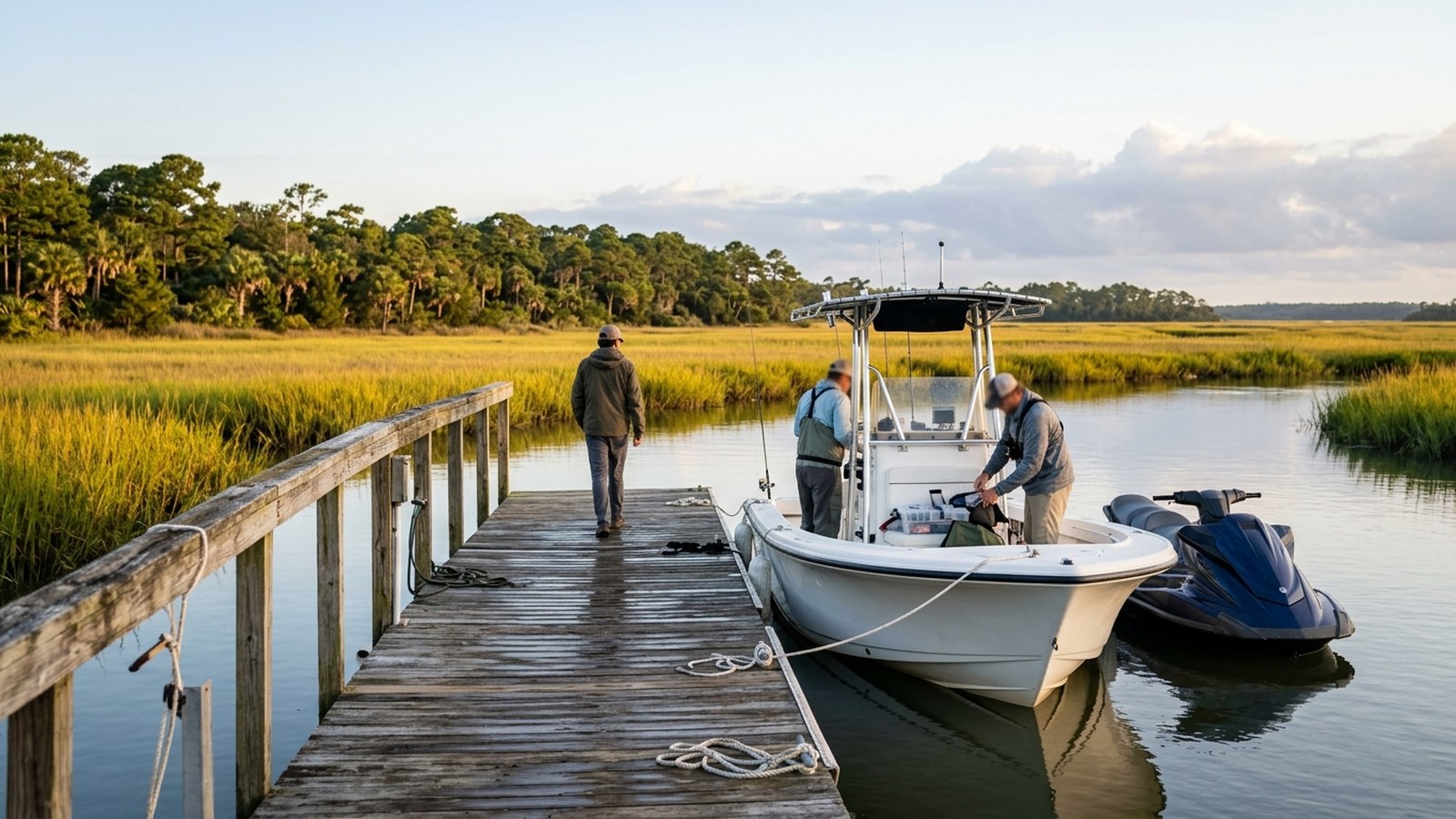
Myrtle Beach, the Grand Strand, Charleston, and coastal North Carolina share a simple pattern. People keep boats and jet skis for recreation, fishing, and short hops between inlets. The same water that makes weekends special also multiplies exposure: other boats in crowded channels, docks and pilings, shallow spots that eat lower units, and a long Atlantic hurricane season that runs from June 1 through November 30.[3][4]
Recreational boating still produces real human and property losses nationwide. In calendar year 2024, the U.S. Coast Guard verified 3,887 recreational boating incidents involving 556 deaths, 2,170 injuries, and about $88 million in property damage.[5] Collisions, groundings, operator inattention, and inexperience show up repeatedly in those data sets. Insurance does not replace safe operation, life jackets, or weather discipline. It does decide who pays when a hard day on the water turns into a repair bill, a medical claim, or a lawsuit.
As an independent agency serving coastal and inland Carolinas, we help owners match coverage to how the boat is actually used: trailered center console, slip-kept cruiser, bay boat for the marsh, or a pair of PWCs for summer guests. The right fit is rarely the cheapest quote alone. It is the policy that still makes sense after you read the hull valuation method, the liability limit, the navigation territory, and the storm language.
Hull coverage: your boat as property
Hull coverage (physical damage) is the part of a boat policy that addresses loss or damage to the vessel itself. The Insurance Information Institute describes common physical-damage protection as applying to the boat, including the hull, machinery, fittings, furnishings, and permanently attached equipment, along with theft and other named or open perils depending on the form.[1] Exclusions can still bite. Normal wear and tear, certain marine growth or animal damage, and defective machinery are examples of items policies often push outside covered loss.[1]
Two valuation methods matter more than marketing language:
- Actual cash value (ACV) pays replacement cost minus depreciation at the time of loss. For a total loss, market guides and comparable sales help set the boat's approximate value. Partial repairs may also reduce payment for age and condition.[1]
- Agreed amount (agreed value) uses a value you and the insurer set in advance. On a total loss, that agreed amount is what the policy is designed to pay. On many agreed-value forms, partial losses may also settle without the same depreciation haircut used on ACV forms.[1]
For coastal owners, agreed value is often worth a calm conversation when the boat is newer, recently refurbished, or hard to replace quickly during peak season. ACV can fit older vessels where premium savings matter more than replacing like-for-like after a total loss. Neither choice is "wrong." The gap shows up when someone assumes a $45,000 boat still settles near purchase price five years later under an ACV form.
Hull deductibles, lay-up periods, and named-storm deductibles (when used) also change the out-of-pocket math. Some policies treat wind or hurricane events with a separate deductible schedule. Others condition coverage on how and where the boat is stored during storm season. Read those conditions before the first tropical depression appears on a National Hurricane Center track map.
Liability: the layer that protects more than fiberglass
Liability coverage on a boat policy responds when you are legally responsible for injury to others or damage to someone else's property. III notes that boat policies generally provide broader liability protection than a homeowners policy, and that owners with meaningful assets may also want an umbrella that sits over boat, home, and auto exposures.[1] Bodily injury to people other than the owner (or sometimes the owner's family, depending on form), property damage to another vessel or dock, guest passenger liability, and medical payments for injuries aboard are common building blocks on recreational marine policies.[1]
Why liability dominates coastal risk conversations:
- Crowded waterways. Intracoastal traffic, rental fleets, fishing tournaments, and holiday weekends raise the chance of a multi-boat claim.
- Docks, lifts, and private property. A broken piling or damaged lift can cost more than a cosmetic hull repair.
- Medical severity. Even when property damage is modest, injury claims can escalate.
- Marina and lender contracts. Slip agreements and loan documents often specify minimum liability limits even when state law does not force you to buy a policy.[2]
South Carolina's Department of Natural Resources is clear that state registration laws do not require proof of insurance to register a boat.[2] That is a registration fact, not a risk fact. Operating without liability cover still leaves personal assets exposed if you cause a serious loss. Marinas, yacht clubs, and storage facilities commonly set their own insurance minimums. Financing almost always does too. If you boat in multiple states, local rules and private contracts can differ, so treat "not required for registration" as the floor of the conversation, not the ceiling.
Personal watercraft deserve a separate look. III explains that larger and faster boats, and personal watercraft such as jet skis, generally require a separate policy rather than relying on thin homeowners property limits designed for small, low-power craft.[1] PWC operation often involves younger operators, towing tubes, or high-traffic sandbar areas. Liability limits that feel adequate for a slow-moving pontoon may be light for a PWC claim involving multiple riders.
The homeowners "small boat" trap
A frequent gap we see in coastal households is assuming the home policy already "covers the boat." Many homeowners and renters forms offer only limited property damage for small boats such as canoes, small sailboats, or small powerboats under a low speed threshold (III describes limited coverage for craft with less than 25 mile-per-hour horsepower, covering boat, motor, and trailer combined).[1] Liability for watercraft is often excluded or tightly restricted on the home form unless you add a specific endorsement, and even then the limits and craft types may not match real use.[1]
If your boat:
- is larger or faster than the homeowners exception,
- is a personal watercraft,
- is kept in a marina,
- is financed, or
- is used regularly offshore or on busy ICW stretches,
you should assume you need a dedicated boat or PWC policy until an agent confirms otherwise. Trailer coverage, onboard electronics, fishing gear, and towing after a breakdown may also sit outside a basic home form.[1] Ask for a simple inventory: what is on the boat that would hurt to replace out of pocket?
Storm season on the Carolina coast
Atlantic hurricane season officially runs June 1 through November 30.[3][4] That window is when tropical storms, hurricanes, and the surge and waves that travel with them pose elevated risk to vessels in port and at sea. NOAA's mid-season outlook can change year to year. In August 2026, for example, NOAA maintained a below-normal outlook for the Atlantic basin while still stressing preparedness through the climatological peak in early September.[3] A quieter seasonal forecast is not a free pass for an individual marina or inlet. Landfall risk depends on short-range weather patterns, not the seasonal count alone.[3]
Ready.gov reminds households that hurricanes bring storm surge, wind, flooding, and dangerous currents, and that reviewing insurance policies and important documents is part of before-storm prep.[4] For boat owners, that checklist should include the declarations page, haul-out or relocation plan, marina storm procedures, and photos of the vessel's condition. National Hurricane Center marine guidance emphasizes ongoing risk analysis as forecasts update, early decisions when leaving port, and careful evaluation of berthing and shelter options because wind and storm surge can overwhelm docks and lines that felt secure on a fair-weather afternoon.[6]
Carolina owners often face practical constraints:
- Haul-out slots fill when a storm cone tightens.
- Travel lifts and yard crews work first-come, first-served under marina rules.
- Trailering inland only works if you own a suitable trailer, tow vehicle, and safe storage site.
- Leaving a boat in a "protected" canal is not automatically safer than moving it if surge and debris paths are unfavorable.
Insurance conversations should start before those constraints hit.
Storm-season gaps that show up after the weather clears
Even solid hull and liability policies can leave expensive holes if you never walk through storm language. Common gaps we review with coastal clients:
Liability-only or thin physical damage. A liability-only arrangement may satisfy a marina slip rule yet pay nothing to repair your boat after wind, wave, or debris damage. Physical damage for weather typically lives in comprehensive-style or open-perils hull coverage, subject to deductibles and exclusions. Confirm how your form treats wind and named storms rather than assuming "boat insurance" always means full hull.
No (or limited) hurricane haul-out reimbursement. Some marine policies reimburse part of the cost to professionally haul or secure a boat when a named storm threatens. Others do not. Haul-out labor and crane time can run high on short notice. If reimbursement exists, note triggers (named storm, watch vs. warning, geographic cone), caps, and whether relaunch is included. If it does not exist, budget haul-out as an out-of-pocket preparedness cost.
Storage and navigation warranties. Policies may require the boat to be in a certain location, on a cradle, behind a hurricane hole, or out of commission during defined months. Operating outside declared navigation territory, or leaving a boat in a prohibited area during storm season, can jeopardize claims. Match the policy map to how you actually boat from Horry County to the Lowcountry or the Outer Banks.
Salvage, wreck removal, and pollution. Raising a sunk vessel or removing a wreck from a channel can exceed the visible hull repair. Ask whether wreck removal and pollution liability are included and at what limits. Coastal claims often involve more than a fiberglass patch.
Equipment, trailers, and tenders. Electronics, trolling motors, trailers, and dinghies may need scheduling or separate limits. After a storm, missing inventory documentation slows settlement.
Operator and PWC endorsements. Youthful operators, rental use, or commercial charters change underwriting. A pleasure-use policy is not a substitute for commercial marine cover if you take paying passengers.
Umbrella coordination. A personal umbrella can add high liability limits above boat and auto policies, but only if the underlying boat liability meets the umbrella carrier's required minimums.[1] After you raise boat liability, confirm the umbrella still attaches cleanly.
None of these points require scare tactics. They require a declarations page, a marina contract, and a 20-minute conversation before peak season.
How we think about a coastal boat or PWC review
When we sit down with a Carolina boat owner, we usually walk a short sequence:
- Use profile. Trailered day boat, wet slip, dry stack, multi-week cruising, or PWC only.
- People profile. Who operates, training history, guests, teens, and towing sports.
- Money profile. Loan balance, replacement cost, deductible comfort, and assets that liability should protect.
- Storm profile. Where the boat lives June through November, marina rules, haul-out access, and inland storage options.
- Form profile. ACV vs. agreed value, liability limit, medical payments, uninsured watercraft (if offered), towing, equipment, and storm deductible language.
That sequence keeps the discussion grounded. It also connects to safety habits that reduce claims: life jackets worn, sober operation, lookout, and weather checks. Coast Guard statistics continue to show drowning as a large share of fatal outcomes where cause of death is known, and alcohol as a leading known factor in fatal incidents.[5] Coverage is the financial backstop. Seamanship is the first line of defense.
Practical takeaways
- Treat boat insurance Carolina coast shopping as hull + liability + storm logistics, not a single premium number.
- Do not assume a homeowners policy covers a powered boat or PWC beyond narrow small-craft property limits.[1]
- Choose agreed value when replacing the boat near a set dollar amount matters; understand ACV depreciation if you pick the lower premium path.[1]
- Carry liability limits that fit your assets, marina contract, and guest exposure, then check umbrella attachment.[1]
- Remember SC registration may not require insurance proof, while lenders and marinas often will.[2]
- Plan haul-out, trailer moves, or secure wet storage before a cone narrows; seasonal forecasts do not replace local storm decisions.[3][6]
- Photograph gear, keep serial numbers, and store policy documents where you can reach them after a storm.[4]
- Revisit coverage when you add electronics, change home ports, buy a second PWC, or finance a newer hull.
How we can help
Beach Insurance LLC is an independent agency serving Myrtle Beach, Charleston, Charlotte, and coastal communities across South and North Carolina. We help boat and personal watercraft owners compare options across carriers, explain hull versus liability in plain language, and flag storm-season gaps before they become claim surprises. If you want a practical review of your current declarations page or a fresh quote built around how you actually use the water, start with our personal insurance services or request a free insurance quote. You can also call us at (843) 626-9244. Bring your marina contract, loan requirements, and a short list of how you boat. We will handle the coverage map from there.
Citations
- Insurance Information Institute - "Boat insurance and safety" (III educational article; accessed 2026)
- South Carolina Department of Natural Resources - "Boating - Title and Register a Watercraft or Outboard Motor in SC: Frequently Asked Questions" (SCDNR; accessed 2026)
- National Oceanic and Atmospheric Administration - "NOAA maintains prediction for below-normal Atlantic hurricane season" (2026-08-06)
- Ready.gov / U.S. Department of Homeland Security - "Hurricanes" (updated 2026-07-09)
- U.S. Coast Guard Office of Auxiliary and Boating Safety - "Recreational Boating Statistics 2024" (COMDTPUB P16754.38; published 2025-06-24)
- National Hurricane Center / NOAA - "Marine Safety" (NHC hurricane preparedness guidance for mariners; accessed 2026)