HVAC Contractor Insurance Carolinas: Not One Policy
HVAC contractor insurance Carolinas shops typically need is not one policy. It is a stack that matches how a mechanical contractor actually works: general liability (including claims that show up after the install is finished), coverage for tools and recovery gear that ride in the van, commercial auto for those vans, and workers compensation when South Carolina or North Carolina law says you must carry it. [1][2][3][14][15] The same shop also lives under two other rulebooks that are not insurance at all. Federal Section 608 rules decide who may handle refrigerant. State contractor boards decide who may contract to install or replace heating and cooling systems. [4][5][8][11] We write this for heating and cooling shops in Myrtle Beach, Charleston, Charlotte, Wilmington, and the rest of coastal and inland North and South Carolina, not for electricians or general contractors.
Practical takeaways
- A commercial general liability policy is the first line for injury or property-damage claims tied to your services and jobsite operations. It is not a substitute for workers compensation, and it usually excludes pollution. [1][16]
- After a system is installed, the exposure does not end. A later leak, a failed heat exchanger, or a water-damaged ceiling is a completed-operations conversation, not a van-crash conversation. [1][10]
- Recovery machines, gauges, vacuum pumps, and brazing kits sitting in a service van are movable contractor property. A location-based property form may not be enough. Inland marine (tools and equipment) is the usual fix. [2]
- A business owners policy does not insure the trucks. If the van is titled to the company, a personal auto policy will not respond. [3]
- North Carolina generally requires workers compensation at three regular employees. South Carolina generally requires it at four. Count officers the way each statute actually counts them. [14][15]
- In South Carolina, commercial mechanical work over $10,000 needs a mechanical contractor license. In North Carolina, anyone who contracts to install, alter, or restore heating or air conditioning needs a license from the plumbing, heating, and fire-sprinkler board (minor service is treated differently). [8][9][11]
- EPA Section 608 certification is required to service equipment that can release refrigerant. The card does not expire. Insurance does not replace it. [4][5]
What an HVAC shop actually does (and why the policy has to match)
The U.S. Bureau of Labor Statistics describes heating, air conditioning, and refrigeration mechanics as people who install and repair systems in homes, schools, hospitals, and other buildings. The same handbook notes they may work in cramped spaces, outdoors, or in extreme temperatures, and that they may need a license or certification. BLS counted 425,200 of these jobs in 2024 and projected 8 percent growth from 2024 to 2034, much faster than average, with about 40,100 openings a year. [6]
That is the work we see from Grand Strand split-system changeouts to Charleston rooftop units to Charlotte mechanical rooms. It is also why a generic "contractor" conversation misses the point. An HVAC crew is not primarily hanging drywall. It is charging and recovering refrigerant, lighting or servicing combustion equipment, pulling vacuum on a new coil, setting a condensing unit on a pad or a roof, and driving a loaded van between service calls.
Two federal sources describe the jobsite in more specific terms. OSHA's confined-spaces-in-construction rule lists heating, ventilation, and air-conditioning (HVAC) ducts among the places a confined space can occur, along with boilers, chillers, and pits. [7] A separate OSHA FAQ (still the live agency page) draws a line that shops feel every week: if a technician enters an attic that is a confined space to repair an existing HVAC unit by adjusting it or replacing parts in kind, that is generally treated as maintenance under the general-industry rules. Upgrading the system or its component parts is construction work and falls under the construction confined-space standard. [13]
Electrical energy is another HVAC-specific exposure, not a side note. The Electrical Safety Foundation International's construction-safety brief for this trade (PDF posted May 2024) says OSHA treats heating, air conditioning, and refrigeration mechanics as one of the occupations with the most electrically related workplace fatalities. ESFI reports that 90 percent of those fatalities involved contact with or work near energized conductors or parts, and that 60 percent occurred while a mechanic was troubleshooting or testing a device. [12] That is a service-call fact pattern: a live disconnect, a rooftop unit, a furnace control board, a technician with a meter in hand.
Refrigerant handling sits next to that. EPA regulations under Section 608 of the Clean Air Act require technicians who maintain, service, repair, or dispose of equipment that could release refrigerants into the atmosphere to be certified. The tests are specific to the equipment (Type I small appliances, Type II high- or very high-pressure, Type III low-pressure, or Universal for all three). Credentials do not expire. Apprentices are exempt only if they are closely and continually supervised by a certified technician. [4] Section 608 also prohibits intentionally venting ozone-depleting refrigerants and their substitutes, including hydrofluorocarbons (HFCs), while maintaining, servicing, repairing, or disposing of air-conditioning or refrigeration equipment. [5]
None of those rules is an insurance policy. They do tell you what a Carolina HVAC shop is doing when a claim file opens: working in an attic or a mechanical room, around energized equipment, with refrigerant and (on many heating jobs) gas-fired appliances.
General liability and the claim that arrives after you leave
The Insurance Information Institute describes a commercial general liability (CGL) policy as protection if you are liable for property damage or personal and advertising injury caused by your services, business operations, or your employees. It covers non-professional negligent acts. A typical CGL will usually pay defense costs and damages if you are found liable, up to the policy limits. Standard Coverage A is bodily injury and property damage arising out of those operations. Coverage C is limited, no-fault medical payments for a non-employee hurt on your premises or by your operations. [1]
The U.S. Small Business Administration puts the same product in plainer language. General liability is for any business. It is meant to protect against financial loss from bodily injury, property damage, medical expenses, libel, slander, defending lawsuits, and settlement bonds or judgments. [16]
For an HVAC shop, the daytime version of that policy is easy to picture. A technician cracks a client's tile while rolling a condensing unit through a kitchen. A ladder marks a foyer wall. A helper's tool bag knocks a television off a stand. Those are premises and operations claims. They happen while you are still on the job.
The quieter version is completed operations. III's CGL write-up is built around liability from your services, not only from a customer trip-and-fall in your shop. [1] North Carolina's licensing board tells consumers, in so many words, why that later claim matters. It says improper heating installations that were not permitted and inspected have caused fires, illnesses, injuries, and even deaths, and it tells homeowners to confirm the contractor carries liability insurance (and workers compensation if required). [11] A condensate line that backs up into a ceiling two months after a coil change, a refrigerant leak that ruins stored goods in a walk-in, or a heating installation that is later alleged to have caused a fire is not a "while we were there" story. It is a "after we finished" story.
Two CGL limits matter when you read a certificate for a general contractor or a property manager. There is usually a per-occurrence limit and a separate products-completed operations aggregate. If most of your work is new installs and replacements, that completed-operations number is not a footnote. It is the bucket that later claims draw from. We do not invent a "right" limit here. The right number is the one that matches your contracts, your largest jobs, and how much risk you can actually carry.
What CGL will not do is just as useful. III is explicit that workers compensation and employment-practices liability are excluded (buy them separately). Pollution liability is also excluded. It can sometimes be added by endorsement, but III notes that endorsement coverage is very limited and that higher-risk businesses should consider a separate pollution policy. [1] Refrigerant releases, oil, and other jobsite chemicals are why we raise that exclusion with mechanical contractors instead of assuming the CGL will answer every "something leaked" claim.
CGL also is not a professional-liability (errors and omissions) policy, and it is not a guarantee of your workmanship. A policy may respond to resulting injury or property damage. It does not usually pay to redo a sloppy install simply because the customer is unhappy with the finish. Read the "your work" language with your agent before you assume a callback is a claim.
You can buy CGL on its own, inside a business owners policy, or as part of a commercial package. If the primary limit is not enough, III points to a commercial excess (umbrella) policy as the usual way to sit more limit on top. [1] Many Carolina GCs and commercial property managers will ask for that extra layer on the certificate.
Tools, recovery gear, and the van that is also a warehouse
A location-based property form is written for things that stay put: shop inventory, a front-office computer, parts on a shelf. HVAC tools do not stay put. Recovery machines, micron gauges, vacuum pumps, leak detectors, brazing kits, sheet-metal brakes, refrigerant cylinders, and a day's worth of fittings ride from a Myrtle Beach warehouse to a Pawleys Island changeout, then to a service call in North Myrtle that afternoon.
III's inland marine explainer is the right frame, even if the name sounds like a boat policy. Inland marine covers products, materials, and equipment when they move over land or sit temporarily away from your premises. III lists construction and contracting equipment among the things this coverage is built for. It also notes that a BOP or commercial package may be enough if tools only travel to nearby jobs, but frequent shipping, high-value items, or property that basic forms exclude are reasons to buy a separate inland marine form. An installation floater, in III's list of special inland marine coverages, is meant to cover materials from the moment they are loaded onto a truck until they are put to use or installed. [2]
That last piece is an HVAC install fact. A 5-ton condensing unit and coil sitting on a truck, or on a pad overnight before startup, is not "building property" yet. If it is stolen from the driveway or damaged in transit, the question is whether you scheduled it, whether an installation floater applies, and whether the manufacturer's invoice is sitting in the job file.
Two practical notes keep this from becoming a generic tools lecture. First, make a list. Insurers cannot guess that you own two recovery machines and a $4,000 leak detector. Second, theft from an unlocked van is a different conversation from a wreck. Ask how the form treats tools left in a vehicle overnight, whether there is a per-item limit, and whether rented recovery equipment is included. We will not invent those answers. They vary by form.
Our contractors insurance page is the place we collect the contractor package (general liability, business property, inland marine, and umbrella) for shops that need certificates as often as they need coverage.
Service vans, employee cars, and why the personal auto policy is the wrong tool
III is blunt: a business owners policy does not provide any coverage for vehicles. You need a separate policy. Most states require liability insurance for bodily injury and property damage from a vehicle accident while someone is driving on business. The standard form many insurers use is the Business Auto Coverage Form. "Auto" on that form includes cars, trucks, trailers, vans, and other vehicles designed for public roads. [3]
If the van is owned by the business, III says there will be no coverage under a personal auto policy. If a vehicle is used primarily in business, there is likely no personal-auto coverage either. Occasional business use of a personal vehicle can sometimes be arranged on a personal policy, but III warns that the carrier may charge extra or refuse the risk. A personal umbrella typically excludes claims that arise in the course of a business endeavor. [3]
Hired and non-owned auto (often discussed as HNOA) is the piece shops miss when a lead installer takes a personal pickup to a Saturday no-cool call, or when the office manager runs to the supply house in her own car. III's point is that the business can be sued even when the vehicle is not on the company's title. Non-owned coverage on the business auto form is excess over the employee's personal limits. If those personal limits are only high enough to meet state financial-responsibility minimums, the shop's layer is doing real work. [3]
Physical damage is a separate decision. Collision, comprehensive, and specified-perils are the three usual options. III notes that a physical-damage claim is paid on actual cash value (the lesser of ACV or the cost to repair or replace with like kind and quality), and that it may be cost-effective to carry physical damage only on newer or more valuable vehicles. [3] For an HVAC shop, that often means full physical damage on the late-model high-roof vans and a harder look at an older spare truck.
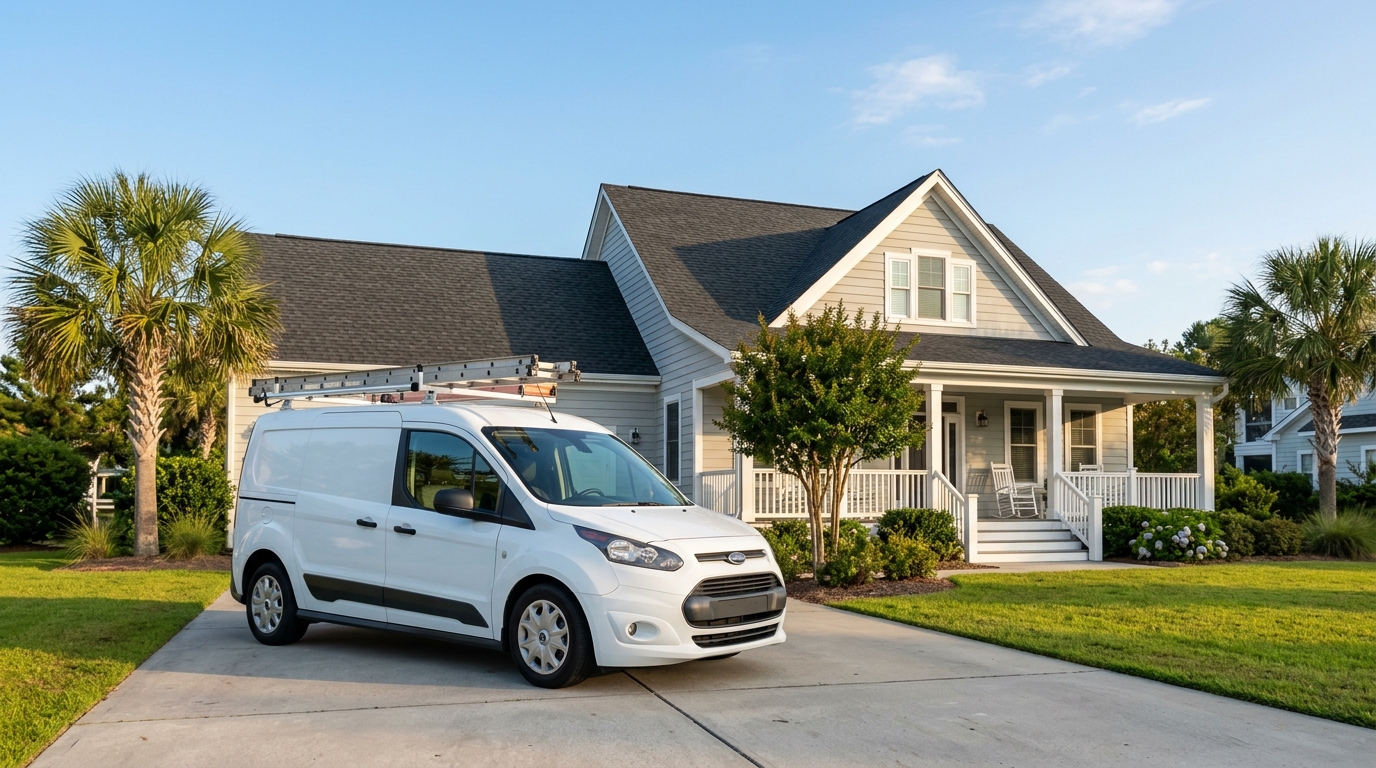
III reports that many insurers recommend a business auto liability limit of $1 million, with $500,000 as the minimum they would want a small business to carry, often written as a combined single limit. Those are industry recommendations, not a quote and not a legal minimum. [3] What we care about for HVAC is the use: ladders on the rack, refrigerant and recovery gear in the cargo area, regular highway miles between coastal jobs and Piedmont service territories, and employees who may take a van home.
If your crews live in their vans, our commercial vehicle insurance page is the companion to this article. The point here is narrower: the van is part of the mechanical trade, not an afterthought.
Workers compensation: two Carolina thresholds, not one
A CGL policy excludes employee injuries. III says so directly. Workers compensation is a separate policy. [1] SBA's launch guide lists workers compensation among the coverages businesses with employees are expected to address, and it reminds owners that some insurance is legally required and that the details vary by state. [16]
North Carolina's Industrial Commission is specific. A business covered by the Workers' Compensation Act must obtain workers compensation insurance or qualify as a self-insured employer. In general, all businesses employing three or more employees on a regular basis are covered. Corporate officers count toward that three-person trigger, though they may exclude themselves from coverage. Sole proprietors, partners, and LLC members are not automatically counted as employees, but they may elect to be included. [14]
South Carolina's statute is written differently. Title 42 defines "employment" to include all private employments in which four or more employees are regularly employed in the same business or establishment. [15]
Those two numbers (three in North Carolina, four in South Carolina) are why a two-tech shop that adds a helper and an office person can cross a legal line without changing how the vans look. We will not tell you a one-person HVAC truck is automatically exempt or automatically required. The statutes have exemptions and special cases. Read your headcount the way the Industrial Commission or the South Carolina commission counts it, including officers.
North Carolina's HVAC licensing board also treats proof of coverage as a consumer issue, not only an employer issue. Its consumer page tells homeowners to make sure the contractor has liability insurance and workers compensation if required, and it warns that few unlicensed contractors have adequate insurance. [11]
Licenses and Section 608: not coverage, but they sit next to the policy
Insurance will not issue your contractor license, and a license will not pay a claim. They still belong in the same conversation because underwriters, general contractors, and building departments ask about both.
In South Carolina, the Contractor's Licensing Board (under LLR) says a general or mechanical contractor's license is required for anyone performing commercial construction over $10,000 in the regulated classifications. [8] The statute is even plainer. No one may practice as a contractor by performing or offering to perform mechanical contracting work for which the total cost of construction is greater than $10,000 without a license. That $10,000 threshold is the figure in the current code, as amended in 2023. [9] "Mechanical construction" in that chapter means the installation, replacement, or repair of plumbing, heating, air conditioning, process piping, refrigeration, and related work. [9] Shops that do only residential work are pointed by LLR to the Residential Builders Commission rather than assumed to hold the commercial mechanical ticket. [8]
In North Carolina, the State Board of Examiners of Plumbing, Heating and Fire Sprinkler Contractors is the board that licenses people who contract in plumbing, HVAC, fuel-gas piping, and fire sprinklers. [10] Its consumer page states that anyone who contracts to install, alter, or restore heating (which includes air conditioning) must have a license from that board. Minor repairs and service work to plumbing and heating systems do not require a state license. [11] To sit for the Heating Group 1, 2, or 3 contractor exam, an applicant must have two years (4,000 hours) of on-site, full-time experience in the related systems. Up to half of that experience may be qualifying academic or technical training. [10] North Carolina has a technical-examination waiver agreement with South Carolina for plumbing and HVAC contractors, but applicants still must pass the North Carolina business-law exam. There is no general license reciprocity with other states. [10]
EPA Section 608 sits on top of both state licenses. If your technicians attach gauges, add or remove refrigerant, or otherwise open a system that can release refrigerant, they need the federal card (or close, continual supervision as an apprentice). [4] The card is not a substitute for a North Carolina heating license or a South Carolina mechanical license. It is also not a pollution policy. It is the compliance piece that belongs in the personnel file next to the driving record and the workers-comp notice.
How the stack looks on a real Carolina shop
A two-truck residential service company in Horry or New Hanover County, a five-crew new-construction mechanical shop bidding Charleston multifamily, and a commercial rooftop contractor running I-77 between Charlotte and the Upstate do not buy identical packages. They do buy the same four conversations.
- Liability while you are on site, and liability after you leave. CGL, completed-operations limits that match the work, and a hard look at the pollution exclusion if refrigerant or other releases are part of the job. [1][16]
- The gear that moves. Inland marine or a scheduled tools form for recovery equipment and install materials that are not yet part of the building. [2]
- The vans. A business auto policy on company vehicles, plus non-owned coverage if anyone uses a personal vehicle on shop business. [3]
- The people. Workers compensation once you hit the North Carolina or South Carolina threshold, and a clear decision about whether owners are on or off the policy. [14][15]
Certificates of insurance are the paperwork version of that stack. A property manager in Mount Pleasant or a GC in Raleigh will ask for additional-insured wording, waiver of subrogation, and sometimes a specific completed-operations endorsement. Those are form questions. Bring the contract language when you ask us to issue the certificate, rather than asking us to guess what "standard GC requirements" means.
How we can help
Beach Insurance LLC is an independent agency serving Myrtle Beach, Charleston, Charlotte, and communities across coastal South Carolina and North Carolina. If you run a heating and cooling shop, we can map general liability and completed operations, tools on the trucks, commercial auto, and workers compensation against the work you actually do, then shop that package among the carriers we appoint. Start with a free quote or call (843) 626-9244. You can also reach us at info@beachinsurancellc.com or through our contact page.
Citations
- Insurance Information Institute, "Commercial general liability insurance" (n.d.)
- Insurance Information Institute, "Understanding inland marine insurance" (n.d.)
- Insurance Information Institute, "Business Vehicle Insurance" (n.d.)
- U.S. Environmental Protection Agency, "Section 608 Technician Certification Requirements" (updated 2026-07-15)
- U.S. Environmental Protection Agency, "Stationary Refrigeration and Air Conditioning" (updated 2026-06-22)
- U.S. Bureau of Labor Statistics, "Heating, Air Conditioning, and Refrigeration Mechanics and Installers" (last modified 2025-08-28)
- Occupational Safety and Health Administration, "1926.1201 - Scope" (confined spaces in construction; 80 FR 25519, 2015-05-04)
- South Carolina LLR, Contractor's Licensing Board, "General Information" (n.d.)
- South Carolina Code of Laws, "Title 40, Chapter 11 - Contractors" (Section 40-11-30 threshold amended 2023-05-19)
- North Carolina State Board of Examiners of Plumbing, Heating and Fire Sprinkler Contractors, "Applicant Information" (n.d.)
- North Carolina State Board of Examiners of Plumbing, Heating and Fire Sprinkler Contractors, "Consumer Awareness" (n.d.)
- Electrical Safety Foundation International, "Construction Safety: Heating, Air Conditioning, and Refrigeration Mechanics" (PDF posted 2024-05)
- Occupational Safety and Health Administration, "Confined Spaces in Construction - Frequently Asked Questions" (updated 2016-06-01)
- North Carolina Industrial Commission, "Employers" (n.d.)
- South Carolina Code of Laws, "Title 42, Chapter 1 - Workers' Compensation" (Section 42-1-150)
- U.S. Small Business Administration, "Launch your business" (Get business insurance section) (n.d.)