Golf Cart Insurance Carolina Coast: SC & NC Rules
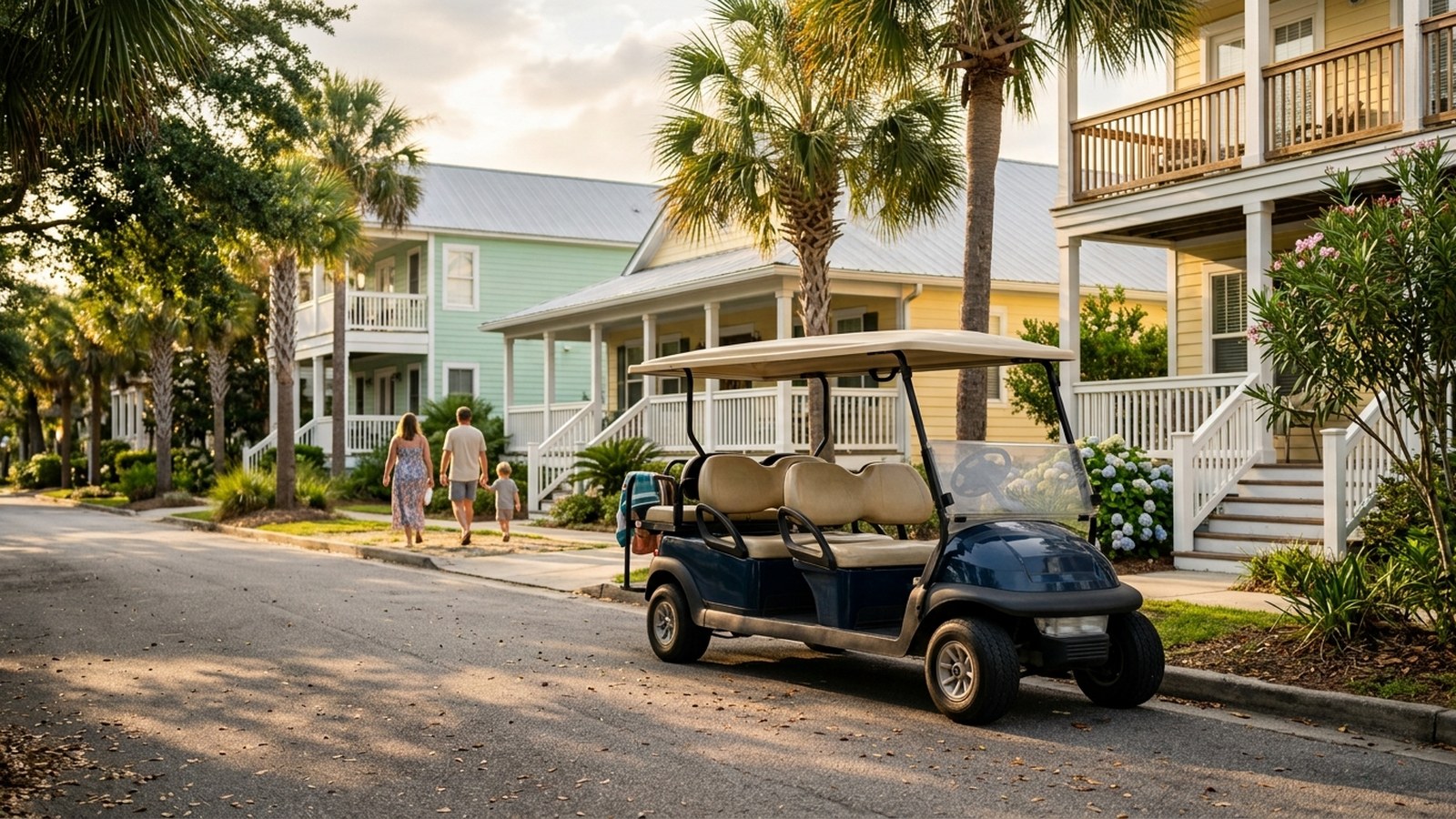
Golf cart insurance on the Carolina coast is not one-size-fits-all. In South Carolina, if you operate a golf cart on a public highway, state rules generally require a permit and registration, liability insurance, a licensed driver age 16 or older, and proof of insurance in the vehicle.[1][2] North Carolina leans more on local ordinances for ordinary golf carts, while low-speed vehicles (LSVs) are typically titled, registered, and insured more like other motor vehicles.[3][7] A home or auto policy may leave gaps once the cart leaves your driveway, so matching liability and physical damage options to how you actually use the cart is the practical way to stay protected.
Why coastal communities treat carts differently
Along Myrtle Beach, the Grand Strand, barrier islands, and many planned communities from coastal South Carolina into coastal North Carolina, golf carts and neighborhood electric vehicles do more than ferry clubs and coolers. People use them for short trips to the beach access, the clubhouse, dinner nearby, or a friend’s house a few streets over. That mix of private paths, gated roads, and public streets is exactly why coverage questions come up so often.
Insurance follows how the vehicle is classified and where it is driven, not just the fact that it looks like a golf cart. Consumer guidance from major carriers is consistent on that point: requirements depend on public versus private use, local rules, and whether the unit is a traditional cart or a street-oriented low-speed vehicle.[4][5] If your cart lives only on a private course or your own lot, the legal picture can look very different from a cart that regularly rolls onto public secondary roads at 20-plus miles per hour.
For homeowners and second-home owners on the coast, that distinction matters. A cart that is mainly recreation on private property is a different risk profile from a daily neighborhood runabout that crosses traffic, parks near commercial strips, or carries guests who may not know local rules.
South Carolina: permits, liability, and proof in the cart
South Carolina has a clear statewide framework for golf carts on public highways. The South Carolina Department of Public Safety’s golf cart checklist states that the cart must be insured, permitted, and registered with SCDMV; that the driver must be at least 16 with a valid driver’s license; and that the driver must carry the registration certificate and proof of liability insurance while operating on a public highway.[1]
SCDMV’s own golf cart page explains how to obtain the permit: complete the Golf Cart Permit Registration form, provide proof of insurance for the golf cart, provide a valid driver’s license number, and pay a five-dollar fee. Once issued, the permit decal goes on the cart and the registration document stays with the cart. Permits are replaced every five years or when the owner changes address.[2]
South Carolina law (Title 56, Chapter 2) restates those duties in statute. To operate a golf cart on a public highway, the owner must obtain a permit decal and registration from the Department of Motor Vehicles, provide proof of ownership and proof of liability insurance, and pay the fee. An operator must be at least 16, hold a valid license, and have the registration certificate, proof of liability insurance that conforms to Section 38-77-140, and the driver’s license in possession. Passengers under 12 must wear a fastened safety belt when the cart is on public streets and highways.[3]
Default operating rules (when a local ordinance does not set different hours or locations within the statewide speed-limit limit) include daylight operation only, secondary highways where the posted speed limit is 35 mph or less, and a four-mile radius from the address on the registration (or from a gated community entrance when the registration address is inside that community). Municipalities and counties may adjust hours, methods, and locations by ordinance, still limited to highways posted 35 mph or less, and they may allow night operation if the cart has working headlights and taillights.[1][3]
What that means for insurance is straightforward. If you plan to drive on public roads under the golf cart permit system, liability coverage is not optional paperwork. It is part of the permit path and part of what you must be able to show on the road.[1][2][3]
Low-speed vehicles are not the same as ordinary golf carts
Coastal driveways often hold two different kinds of small four-wheel machines that people casually call “golf carts.”
A traditional golf cart is designed primarily for golf courses and short private runs. A low-speed vehicle (LSV), sometimes discussed alongside neighborhood electric vehicles (NEVs), is a different legal category. Under federal low-speed vehicle rules referenced in South Carolina’s LSV statute, an LSV is generally a four-wheeled vehicle that can go more than 20 mph but not more than 25 mph and must meet Federal Motor Vehicle Safety Standard 500 equipment requirements when operated on highways.[3]
South Carolina treats LSVs much more like other titled motor vehicles. An LSV must be titled and registered, must meet FMVSS 500, and is subject to the same insurance requirements applicable to other motor vehicles under Title 56. Homemade conversions and retrofitted golf carts do not automatically qualify as LSVs for titling purposes; the statute is explicit that the State does not issue VINs to homemade low-speed vehicles or retrofitted golf carts for that pathway.[3]
In practice, that often means LSV owners need motor-vehicle-style financial responsibility (liability at least at state minimums for motor vehicles) rather than assuming a limited homeowners exception will carry them on public streets.[3][8]
North Carolina: local rules for carts, motor-vehicle rules for LSVs
North Carolina’s approach for ordinary golf carts is more decentralized. G.S. 160A-300.6 allows a city, by ordinance, to regulate golf cart operation on public streets, roads, or highways where the speed limit is 35 mph or less within city limits (or on city-owned or leased property). The ordinance may require registration, charge a fee, specify who may operate, and set equipment, load, hour, and method rules. No person under 16 may operate a golf cart on a public street, road, or highway under that statute.[7]
So in many coastal North Carolina towns, whether you can drive a cart on public streets, and what insurance you must show for a local permit, depends on the local ordinance. Beach and island communities that allow carts often pair registration with liability insurance and safety equipment. Always check the town or county where you keep and drive the cart, not only statewide talking points.
For low-speed vehicles, local governments and NCDMV processes typically treat the unit as a registered vehicle. Town guidance in coastal communities commonly requires registration, inspection or equipment compliance, and valid insurance before an LSV plate is issued and while the vehicle is operated.[9] If your cart has been set up and registered as an LSV, plan for insurance that meets North Carolina financial responsibility expectations for registered motor vehicles, not for a pure private-property recreational cart.
When a home or auto policy is not enough
Many owners assume the cart is “already covered” because they have a homeowners policy and an auto policy. Sometimes there is limited help. Often there is not enough help for coastal use patterns.
Consumer education from State Farm notes that homeowners or renters insurance may provide limited liability for some golf cart claims, especially when the incident is on your property, but that coverage is often excluded for accidents off your property. Those policies also typically do not cover damage to the cart itself the way a dedicated vehicle policy would.[4] Auto insurance may cover a golf cart only if the cart is specifically listed on the policy or if a separate policy is written for that exposure. If the cart is not listed, it is typically not covered under the household auto policy.[4]
NAIC consumer guidance on auto coverage also reminds people that a standard auto policy is built around private passenger cars. Specialty vehicles (motorcycles, ATVs, off-road vehicles, RVs, and similar) are generally outside that ordinary auto contract unless you arrange appropriate coverage.[6]
Progressive’s golf cart materials make a related point: insurance requirements vary by state, and even where a separate golf cart policy is not mandated, liability coverage can help if you are responsible for injuries or property damage while operating the cart. Physical damage options (often collision and comprehensive, or a combined physical damage form on recreational vehicle policies) address theft, vandalism, weather, fire, and crash damage to the cart itself.[5]
For Carolina coast owners, common gap scenarios include:
- Driving off your lot through a neighborhood where the cart functions like transportation, not just yard equipment.
- Crossing or sharing public secondary roads under a SC golf cart permit.
- Operating in an HOA or gated community that requires proof of liability even on private community roads.
- Using a higher-value lifted cart, custom body, lithium battery pack, sound system, or enclosures without physical damage coverage sized to the real replacement cost.
- Lending the cart to family or house guests who may not understand local speed, lighting, or passenger rules.
- Owning an LSV registered as a motor vehicle while still thinking of it as “just a golf cart” for insurance purposes.
None of those situations mean you need the most expensive policy available. They do mean you should not assume your home and auto package already answers the question.
Liability, physical damage, and how use drives the design
A useful way to shop golf cart insurance Carolina coast options is to separate liability from physical damage, then match both to real use.
Liability pays others when you are responsible for bodily injury or property damage. In South Carolina, golf cart operators on public highways must carry proof of liability insurance that conforms to the state’s motor vehicle liability framework in Section 38-77-140.[3] The South Carolina Department of Insurance explains that the state’s minimum auto liability structure is $25,000 per person for bodily injury, $50,000 per accident for bodily injury, and $25,000 for property damage, with uninsured motorist coverage also required at those minimum liability amounts for drivers who must meet auto insurance law.[8] Minimums are a floor, not a recommendation for every household. Coastal carts share space with pedestrians, bikes, pets, parked cars, landscaping, and guests. Higher liability limits (and sometimes a personal umbrella that follows after underlying limits) can be a practical conversation when your home, savings, and rental exposure sit next to a frequently used cart.
Physical damage (collision and comprehensive, or a combined form) responds to damage to your own cart. That can matter after a tip-over, a collision with a gate or another vehicle, theft from a driveway or beach parking area, vandalism, fire, or storm-related loss. If the cart is financed, a lender may require physical damage coverage. If the cart is paid for but expensive to replace, physical damage is a budget and risk-tolerance choice rather than a pure legal checkbox.
Medical payments, uninsured motorist, and accessory coverage appear on many golf cart and recreational vehicle style policies and can fill gaps for passenger injuries, uninsured drivers, and installed equipment, depending on the form.[4][5]
How you use the cart should steer the structure:
- Course-and-driveway only: confirm any homeowners limited liability, HOA rules, and whether you still want physical damage for theft or storm.
- Neighborhood and short public-road trips under SC permit rules: prioritize liability that satisfies permit and proof-of-insurance duties, then size physical damage to cart value.
- Street-legal LSV / NEV use: expect motor-vehicle-style registration and insurance discipline, equipment compliance, and limits that meet state financial responsibility for registered vehicles.[3][9]
- Rental, resort, or commercial guest transport: that is a different exposure and may need commercial or special-use review rather than a personal recreational form.
HOAs, rentals, and multi-home coastal households
Independent of state statute, many coastal HOAs and planned communities set their own rules for carts on private roads: registration stickers, minimum liability, headlight rules, age rules, and quiet hours. Those private rules can require insurance even when a pure private-property state analysis would not. Keep a current declarations page or proof card with the cart the same way you keep SC registration documents.
Second homes and short-term rentals add another layer. If guests use the cart, ask who is an allowed operator under the policy, whether the cart is stored securely between stays, and whether rental use changes eligibility. If you manage a small commercial operation (shuttles, resort amenities, course fleets), personal golf cart insurance is usually the wrong product. Our commercial lines team can help separate personal neighborhood use from business use when those lines blur.
Practical checklist for Myrtle Beach and coastal NC/SC owners
- Identify the vehicle: traditional golf cart versus titled LSV/NEV, and whether speed or equipment modifications change classification.[3][4]
- Map where it is driven: private lot only, gated community roads, public secondary roads, or mixed.
- For South Carolina public-road use, confirm SCDMV permit, decal, registration, age/license rules, and liability proof that matches Section 38-77-140.[1][2][3]
- For North Carolina public-street golf cart use, read the city or county ordinance under the local authority framework in G.S. 160A-300.6 (and related county authority where applicable).[7]
- Read your homeowners and auto policies for motor vehicle exclusions and any limited golf cart exception. Do not rely on marketing assumptions.[4][6]
- Choose liability limits with real coastal exposure in mind, not only the statutory minimum when a minimum applies.[8]
- Decide on physical damage based on cart value, financing, storm and theft exposure, and how hard the cart would be to replace mid-season.
- Document operators (teens, house guests, caretakers) and store proof of insurance with the cart when the law or HOA requires it.[1]
Practical takeaways
- Golf cart insurance Carolina coast decisions start with classification (cart vs LSV) and location (private, community, or public road), not with a generic “yes or no.”
- South Carolina public-highway golf cart operation generally requires SCDMV permit/registration, liability insurance, a licensed driver 16+, and proof of insurance on board.[1][2][3]
- North Carolina cities may regulate golf carts by ordinance on streets posted 35 mph or less; check local rules, and treat registered LSVs more like other insured motor vehicles.[7][9]
- Homeowners coverage may help on your property in limited ways and often excludes off-property cart accidents; standard auto usually will not cover a cart that is not scheduled.[4][6]
- Liability protects others; physical damage protects the cart. Match both to how often you leave the driveway and how much the cart is worth.
- An independent agency can compare options across carriers and fit coverage to real coastal use instead of forcing one product type.
How we can help
Beach Insurance LLC is an independent, Trusted Choice agency serving Myrtle Beach, Charleston, Charlotte, and coastal communities across North and South Carolina. We help personal lines clients sort golf cart, LSV, auto, and homeowners questions side by side so gaps and overlaps are easier to see. If you want a clear review of liability and physical damage options for how your cart is actually used, request a quote or call us at (843) 626-9244. You can also reach our team at info@beachinsurancellc.com or through our contact page.
Citations
- South Carolina Department of Public Safety, "Golf Cart Law" (accessed 2026)
- South Carolina Department of Motor Vehicles, "Golf Carts" (accessed 2026)
- South Carolina General Assembly / Code of Laws, "Title 56, Chapter 2 - Specialized Vehicles (including §§ 56-2-90, 56-2-100, 56-2-120)" (2025 Act No. 64 for golf cart provisions; LSV provisions as codified)
- State Farm, "Do Golf Carts Need Insurance?" (2026-07-22)
- Progressive, "Golf Cart Insurance" and related Answers guidance (accessed 2026)
- National Association of Insurance Commissioners (NAIC), "What Does Auto Insurance Cover?" (accessed 2026)
- North Carolina General Assembly, "G.S. 160A-300.6. Regulation of golf carts on streets, roads, and highways" (accessed 2026)
- South Carolina Department of Insurance, "Automobile Insurance" (minimum liability and UM framework) (accessed 2026)
- Town of Oak Island, NC, "Low Speed Vehicles" (insurance and registration guidance for LSVs) (accessed 2026)