auto glass coverage Carolinas: SC and NC rules
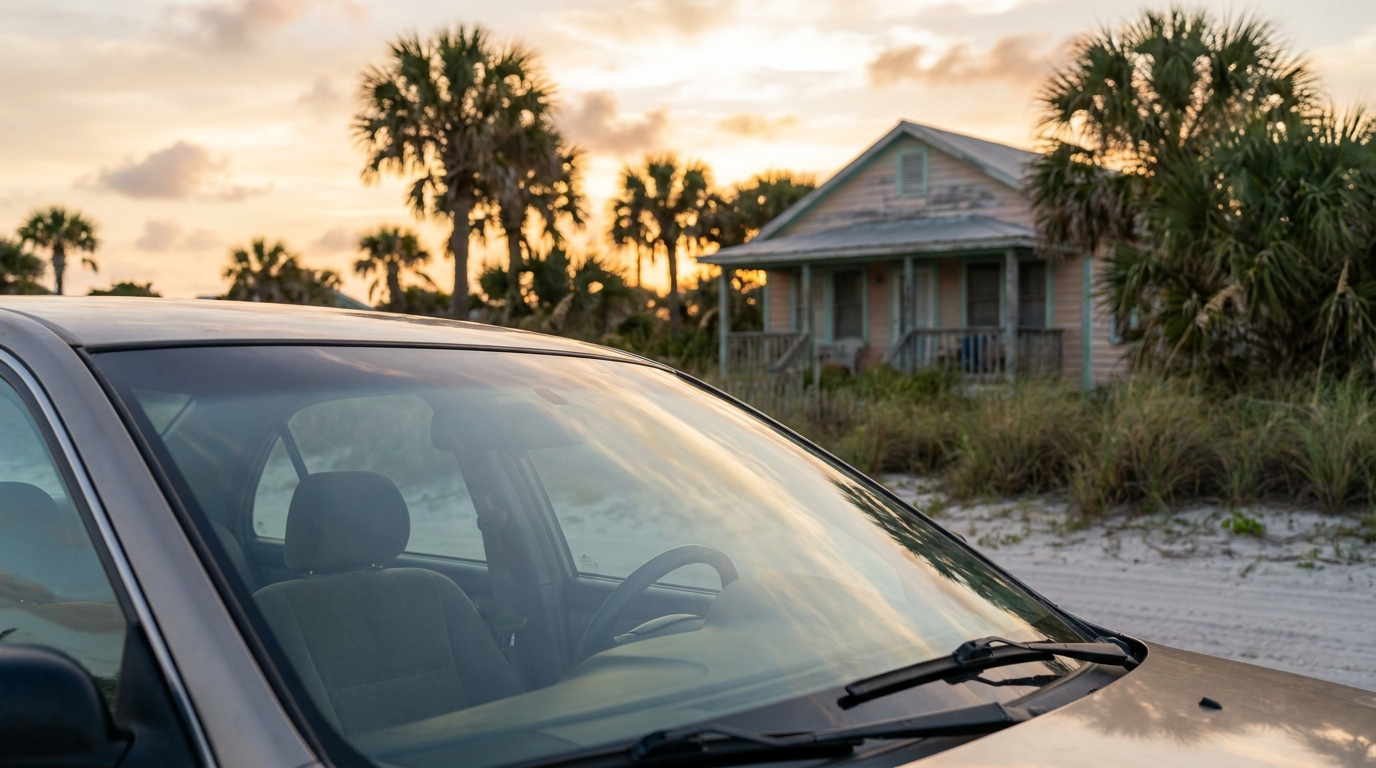
Auto glass coverage Carolinas drivers ask about is a comprehensive question first. A cracked windshield is the example both state consumer pages use. Breakage of glass is the comprehensive cause that also reaches a side window on the North Carolina guide. Liability responds to injury and to property a driver damages. Comprehensive physical damage is the part that insures the vehicle itself [1][5].
The deductible is where South Carolina and North Carolina part company. South Carolina Code Section 38-77-280(B) says any automobile physical damage insurance coverage deductible or policy deductible does not apply to automobile safety glass [3]. The South Carolina Department of Insurance says insurers cannot impose a deductible for safety glass repairs or replacements, and that this is not free glass coverage. Comprehensive has to be on that vehicle [1][2]. North Carolina's Department of Insurance says comprehensive pays the cost of repair or actual cash value less any deductible, and lists breakage of glass as a comprehensive cause [5]. A July 22, 2026 department post says comprehensive will pay to repair or replace a windshield cracked by gravel, and that collision and comprehensive come with deductibles [6]. Those North Carolina pages do not state a deductible waiver for glass. We stop there.
A repair fills limited damage and leaves the glass on the vehicle. A replacement removes it and installs a new piece. A May 16, 2026 summary of a voluntary laminated-glass repair standard draws size and condition lines between those jobs, and it says the standard is not a statute [9]. The policy draws a separate line about what gets paid. The declarations page still shows whether comprehensive is on the auto, which deductible is printed, and whether a glass term was added.
Glass sits inside comprehensive
South Carolina's Department of Insurance describes physical damage as coverage for the insured vehicle. Collision and comprehensive are the most common types, and both are optional to purchase. Comprehensive pays for damage from fire, vandalism, flooding, theft, falling objects, and collision with animals. The same page says comprehensive will also cover broken glass, such as damage to a windshield. A lender may still require both coverages even though state law does not [1].
North Carolina's consumer guide uses the same split. Collision means physical damage from impact with a vehicle or an object, and it pays the lesser of the cost of repair or actual cash value. Comprehensive pays the cost of repair or actual cash value less any deductible. The guide treats these as comprehensive claims: missiles or falling objects, fire, theft or larceny, explosion or earthquake, windstorm, hail, water or flood, malicious mischief or vandalism, riot or civil commotion, contact with a bird or animal, or breakage of glass [5]. The July 22, 2026 post gives the plain example: comprehensive pays to repair or replace a windshield if gravel cracks it [6].
Breakage of glass is not written as a windshield-only cause on that North Carolina guide, so a side window can share the same part when the facts fit [5]. The gravel example on the 2026 post is specifically a windshield [6]. The Insurance Information Institute says comprehensive may reimburse the policyholder if a windshield is cracked or shattered, and that some companies offer separate glass coverage with or without a deductible [7]. A separate glass term is on the policy. We do not assume it.
Collision gets one sentence of contrast. If a collision is what breaks the glass, the insured may elect to have that breakage treated as a collision loss. The election is in ISO personal auto policy PP 00 01 09 18, as quoted in the October 10, 2022 FC&S analysis of Part D, and the analysis says it can let the insured use the lower deductible, depending on how the deductibles were set [8]. That policy pays the comprehensive cause only when the declarations show the coverage for that auto [8].
Deductibles are not the same rule in each state
Section 38-77-280(B) states that any automobile physical damage insurance coverage deductible or policy deductible does not apply to automobile safety glass [3]. The department's auto page says insurers cannot impose a deductible for safety glass repairs or replacements [1]. The auto FAQ answers the free-windshield question in plain words. There is no free glass coverage in South Carolina. If the insured has comprehensive on the auto, the deductible for glass coverage is waived under Section 38-77-280(B) [2]. Comprehensive must be on that vehicle for the insurer to replace the windshield, and in that case the comprehensive deductible is waived [2].
The statute says "automobile safety glass," not a windshield-only sentence [3]. The department applies the no-deductible statement to safety glass repairs and replacements, and uses a windshield as the broken-glass example [1]. The FAQ is written around windshield replacement [2]. We will not treat that wording as a ruling on every panel, including a sunroof.
North Carolina does not inherit the South Carolina rule. The consumer guide subtracts any deductible from the repair cost or actual cash value [5]. The July 22, 2026 post calls the deductible the amount paid up front before the insurer starts paying [6]. Neither page says the state bars a deductible on a windshield, a side window, or a repair. The Insurance Information Institute says states do not require the purchase of comprehensive, and that some companies offer glass coverage with or without a deductible [7]. If a North Carolina policy waives a glass deductible, that waiver is a term on the policy, not a mandate on the department pages we cite.
South Carolina's waiver is about automobile safety glass, not every comprehensive loss [3]. Hail on a hood, a theft, or a vandalized body panel can still meet the deductible printed on the declarations. The ISO wording quoted by FC&S subtracts any applicable deductible shown in the declarations [8]. In South Carolina, the statute and the department say that deductible is not imposed on safety glass repairs or replacements when the physical-damage coverage is in place [1][3].
Repair and replacement are different jobs
A repair leaves the laminated windshield in place and fills the break. A replacement removes that glass and installs a new piece.
On payment, ISO policy PP 00 01 09 18, in the October 10, 2022 FC&S analysis, limits liability to the lesser of actual cash value or the amount necessary to repair or replace the property with property of like kind and quality [8]. If a repair or replacement is better than like kind or quality, the insurer will not pay for that betterment [8]. North Carolina's guide is in the same family: comprehensive pays the cost of repair or actual cash value, then subtracts any deductible [5]. South Carolina's department puts both a safety-glass repair and a safety-glass replacement outside the deductible [1]. On that page, choosing replacement does not turn the safety-glass deductible back on.
On repairability, LegalClarity's May 16, 2026 article summarizes the Repair of Laminated Automotive Glass Standard, ANSI/AGSC/NWRD/ROLAGS 002-2022 [9]. The page calls it a voluntary industry standard, says it is not law, and says no federal or state statute requires compliance [9]. For damage in the outer layer, the summary reports these ceilings: a bullseye no larger than one inch (25 mm), a half-moon no larger than one inch (25 mm), a star break no larger than three inches (75 mm), a combination break whose body, excluding legs, does not exceed two inches (50 mm), and a crack no longer than 14 inches (350 mm) [9]. If the impact goes through both glass layers, or the plastic interlayer is damaged, the summary says the standard calls for full replacement regardless of size [9]. The same article says many insurers still adjust at a six-inch crack, while the summary's account of the standard goes to 14 inches (350 mm) [9]. That six-inch line is an adjusting practice on the page. It is not a South Carolina statute and it is not a North Carolina statute.
Federal glazing rules do not set the deductible. Standard No. 205, at 49 CFR 571.205, requires glazing materials for motor vehicles to conform to ANSI/SAE Z26.1-1996 unless the standard provides otherwise [10]. That is a materials rule. It does not waive a deductible, and it does not choose repair over replacement.
North Carolina's equipment statute is a different subject from the insurance pages. G.S. 20-135 makes it unlawful, in the situations the section describes, to operate a North Carolina-registered motor vehicle manufactured or assembled on or after January 1, 1936, unless it has safety glass wherever glass is used in doors, windows, windshields, wings, or partitions [12]. Safety glass, in that section, is glass treated or combined so it reduces the chance of injury when cracked or broken, compared with ordinary sheet glass or plate glass [12]. The section does not waive a comprehensive deductible.
Original equipment is not a state glass mandate
Section 38-77-280(B) speaks to the deductible and automobile safety glass [3]. It does not name a brand of glass, and it does not require original-equipment glass [3].
North Carolina regulates disclosure when an estimate uses parts not made by the original manufacturer, and the statute names glass. G.S. 58-36-95 requires a written disclosure, on the estimate or on a document attached to it, that the estimate was prepared with automobile parts not made by the original manufacturer [11]. The notice says those parts must be at least equivalent in fit, quality, performance, and warranty to the original manufacturer parts being replaced [11]. The same section makes it a violation of G.S. 58-3-180 to place a nonoriginal windshield, or nonoriginal auto glass, on a vehicle and invoice it as an original repair part [11]. Equivalence and a truthful invoice are the rules on that page. A duty to use only original-equipment glass is not.
South Carolina shop rules, with a limit
Section 38-57-75 governs claim handling, not the deductible [4]. When glass on a motor vehicle is damaged, the insurer providing glass coverage, and a third-party administrator that administers that glass coverage, must not require repairs by one particular provider [4]. The section took effect January 1, 2013 [4].
The statute limits its own reach. It does not apply to an insurer or third-party administrator without a ten percent or greater ownership interest in a vehicle glass repair business [4].
Where the section applies, the insurer or administrator must ask, after coverage is verified and the damage is evaluated, whether the insured has a provider of choice [4]. If the shop is outside the preferred list, they must confirm that the shop will work at the insurer's fair and reasonable rate. If the shop refuses, the insured may be told that additional cost is the insured's responsibility. If the shop accepts, it is paid that rate [4]. Section 38-77-280(B) does not promise payment of every shop's full bill [3]. An amount above the insurer's rate can still fall to the insured under Section 38-57-75 when that section applies and the shop will not accept the rate [3][4].
The section also bars a glass facility from saying the insured is entitled to a free windshield, and from marketing a windshield replacement claim as free [4]. That matches the department FAQ. The deductible can be waived. The coverage is not free, because comprehensive has to be on the vehicle [2]. The owner, lessee, or insured driver, or a designee, must be party to filing the glass repair claim, also called first notice of loss. A glass repair provider may not be that designee [4].
The North Carolina department pages cited here do not state a matching shop statute. Who does the work, and at what rate, stays a policy and claim question on those pages.
What still has to be on the policy
Comprehensive is optional in South Carolina unless a lender requires it [1]. The Insurance Information Institute says states do not require comprehensive, and that a lender may insist on it until a car loan is paid off [7]. North Carolina's July 22, 2026 post says a lender will likely require full coverage, collision and comprehensive together, when there is a loan [6]. Without comprehensive on the declarations, the glass cause in the ISO policy is not turned on for that auto [8]. South Carolina's deductible waiver does not create coverage that was never bought. The FAQ says comprehensive must be on the vehicle [2].
Rental reimbursement is a separate coverage. The July 22, 2026 North Carolina post describes rental coverage as paying the cost of a rented car while the vehicle is being repaired [6]. It does not pay for the glass.
Our team starts with the declarations: comprehensive on that vehicle, the printed deductible, and any glass term a company added. In South Carolina we set that next to Section 38-77-280(B) and the department's statement that a safety-glass deductible is not imposed when comprehensive is in place [1][3]. In North Carolina we use the deductible the guide subtracts, unless the policy shows a different glass term [5][7]. We do not invent a dollar deductible.
Practical takeaways
- A windshield is the comprehensive example on both state consumer pages. North Carolina also lists breakage of glass, which is how a side window enters that part when the facts fit [1][5][6].
- South Carolina law says a physical-damage deductible does not apply to automobile safety glass. The department says that is not free coverage. Comprehensive still has to be on the auto [2][3].
- North Carolina's department pages pay comprehensive glass at repair cost or actual cash value less any deductible, including a windshield cracked by gravel. They do not state a glass deductible waiver [5][6].
- Repair and replacement are different jobs. The voluntary standard summary draws size and condition lines, including replacement when both glass layers are penetrated. The policy pays the lesser of actual cash value or the cost to repair or replace with like kind and quality [8][9].
- Section 38-57-75 limits steering in South Carolina and bars a free-windshield pitch, but only for an insurer or administrator with a ten percent or greater ownership interest in a glass repair business [4]. A shop that rejects the insurer's rate can leave additional cost with the insured when that section applies [4].
- The South Carolina deductible section does not require original-equipment glass. North Carolina requires disclosure and equivalence when parts are not made by the original manufacturer, and it forbids invoicing nonoriginal auto glass as an original part [3][11].
How we can help
Have more questions or want to get in touch? Then Contact us
See auto coverage for the page that describes auto insurance as a contract with the insurer against financial loss from an accident [13].
Citations
- South Carolina Department of Insurance, "Automobile Insurance" (n.d.)
- South Carolina Department of Insurance, "Frequently Asked Questions" (n.d.)
- South Carolina Legislature, "Code of Laws, Title 38, Chapter 77" (n.d.)
- South Carolina Legislature, "Code of Laws, Title 38, Chapter 57" (n.d.)
- North Carolina Department of Insurance, "Basic and Miscellaneous Auto Coverages" (n.d.)
- North Carolina Department of Insurance, "Automobile insurance: What's covered and what isn't" (2026)
- Insurance Information Institute, "Auto Insurance Basics" (n.d.)
- PropertyCasualty360 FC&S, "Personal Auto Policy Contract Analysis Part 5" (2022)
- LegalClarity, "ROLAGS: The Repair of Laminated Auto Glass Standard" (2026)
- Electronic Code of Federal Regulations, "49 CFR 571.205, Standard No. 205, Glazing materials" (n.d.)
- North Carolina General Assembly, "G.S. 58-36-95" (n.d.)
- North Carolina General Assembly, "G.S. 20-135" (n.d.)
- Auto coverage page, "Auto/Car Insurance" (n.d.)