manufactured home insurance South Carolina North Carolina
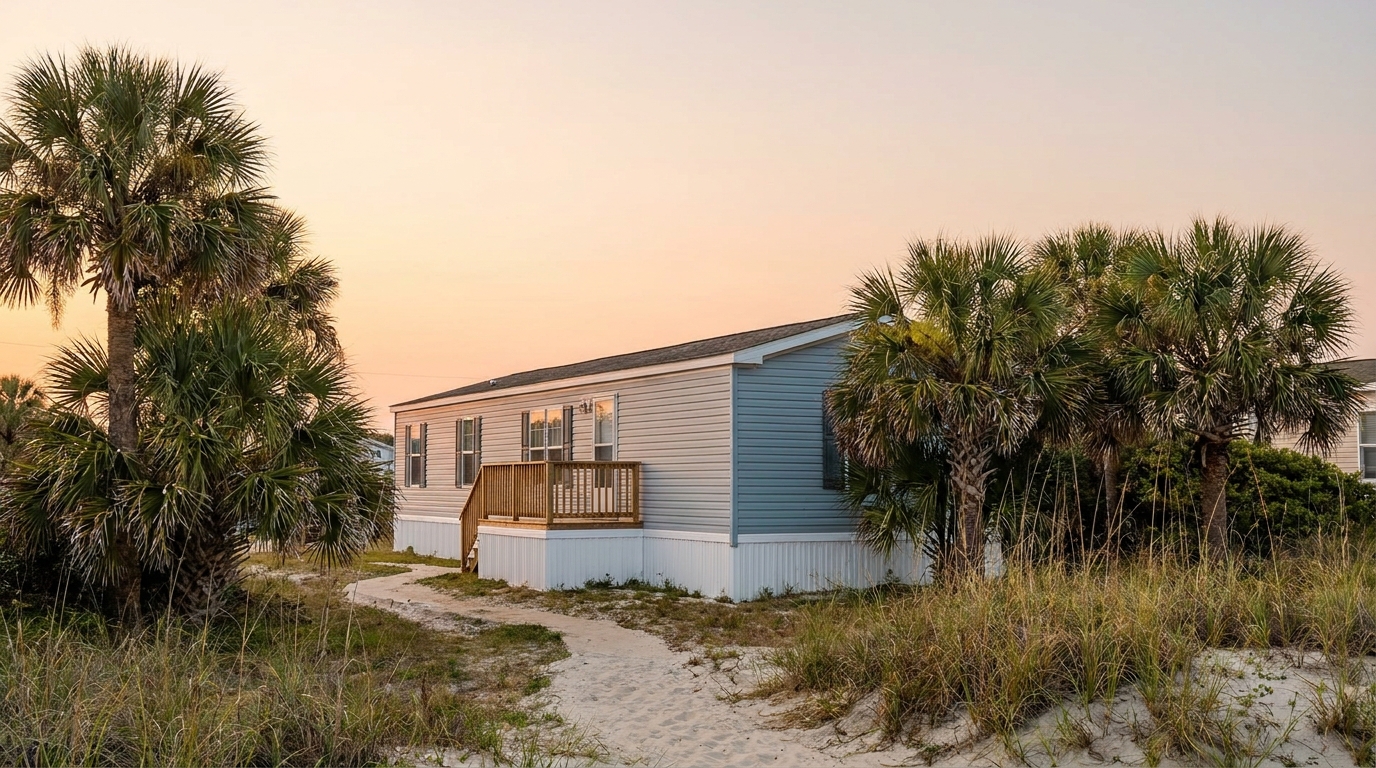
Manufactured home insurance in South Carolina and North Carolina starts from a different building than a site-built homeowners form. The home is plant-built, the setup and any later move can change what the contract pays, and the belongings sit on limits of their own. The Insurance Information Institute describes a mobile home policy as two basic kinds of coverage, physical damage and personal liability, and it states that coverage under a regular policy generally does not apply while the home is in transit. [1]
What the home is
HUD's manufactured housing page describes the building, not a policy. A manufactured home, formerly known as a mobile home, is built to the Manufactured Home Construction and Safety Standards, the HUD Code, and displays a red certification label on the exterior of each transportable section. [2] It is built in a plant and transported in one or more sections on a permanent chassis. [2] The page describes these homes as dwelling units of at least 320 square feet, with the chassis there so the home can be transported at the start and later. [2] Every manufactured home built in the United States after June 15, 1976, must be certified by its manufacturer as built to those standards. [2] The label is that construction certification, not a declarations page. [2]
South Carolina's title statute describes the same kind of building. "Manufactured home" includes a mobile home as defined by law, or a structure, transportable in one or more sections, built on a permanent chassis and designed as a dwelling, with or without a permanent foundation, when connected to the required utilities. [8] The size test is met if, in traveling mode, the structure is eight body feet or more in width or forty body feet or more in length, or if, when erected on site, it is 320 or more square feet. [8] A site-built house does not begin with a traveling mode, a hitch, or a red certification label, so a contract written for one building should not be assumed to fit the next.
How the contract treats the building
On the national page, physical damage coverage pays for accidental damage to the mobile home, to belongings, and to structures such as attached patios, decks, garages, and storage sheds. [1] The causes named there are fire, hail, wind, theft, vandalism, and falling objects, and the amount of coverage varies from one policy to the next. [1] Those options are generally available for a rental mobile home, a commercial mobile home, a home used seasonally, and a home in a park or on private property. [1] A peril policy pays only for specific causes of loss, so damage from a cause the named list does not include is not paid. [1]
North Carolina describes two mobile homeowners forms, MH (C) and MH (F), which may cover the manufactured home, personal property, and personal liability. [5] The forms are similar, with differences in perils and limits. [5] The policy can be named-peril, with the causes named in the contract, or comprehensive. [5] Comprehensive coverage may insure the dwelling and detached structures on an open-perils basis, so a peril that causes direct physical damage is covered unless the policy excludes it. [5] Dwelling coverage protects the home and attached structures if damaged by certain perils, and it covers the original parts, equipment, and accessories furnished and installed by the manufacturer or the dealer. [5] Detached structures on the residence premises are covered as well, and the department's examples are storage buildings and garages. [5] Factory parts and dealer-installed accessories are a split from a site-built homeowners form, which is written around a house assembled on the lot.
Personal liability is the second half of that national description. It responds to a claim or a lawsuit after a person is injured, or property is damaged, because of the insured's activities, and it does not pay injuries to the insured or to household members. [1] A basic homeowners policy also packages liability in Section II, Coverages E and F, so the split between the forms is not liability versus none. [6]
What a loss pays
Section 38-75-220 says an insurer writing mobile home hazard insurance covering loss from physical damage may not issue a policy for more than the value stated in the policy or the value of the property. [3] The insurer and the insured must fix the amount at or before issuance. [3] A total loss from an insured hazard pays the full amount of insurance. [3] A partial loss pays the actual amount of the loss, and not more than the amount stated in the contract. [3] The section still allows replacement by agreement. It does not preclude an agreement to effect replacement after a total loss, if the insured has maintained insurance of a given percentage in relationship to the market value of the mobile home. [3] The statute does not print the percentage. [3] Section 38-75-220 also reaches a hazard the policy insures, not fire alone, unlike Section 38-75-20 in the same chapter, which is a fire rule and does not apply to insurance on chattels or personal property. [3]
Section 38-75-210 limits the term. No hazard policy issued or delivered on a mobile home risk situated in South Carolina may run longer than three years. [4] Premium held for the part of the term after the anniversary of the then-current policy year is unearned and must be refunded in full on cancellation, whether the insured or the insurer cancels. [4]
North Carolina starts from cash value. Physical damage losses are settled on an actual cash value basis, replacement cost less depreciation, unless replacement cost coverage is purchased. [5] The basic homeowners page is written in rebuild-cost language instead. Coverage A is normally the cost to rebuild the house and attached structures. [6] The department says an owner should carry at least 80 percent of full replacement cost, and that the land is not part of the calculation. [6] Replacement cost there means materials of similar kind and quality, with no deduction for depreciation. [6] If the dwelling is insured for less than 80 percent of replacement cost, the insurer may not cover the entire cost to rebuild. [6] That benchmark is the homeowners page, not the manufactured-home page. [5] [6]
Setup, anchoring, and a move
HUD's installation list is about the building, not about a covered cause. The items to consider are local rules for zoning, septic, electrical, and building permits; site preparation and access; stable soil and a foundation system, including anchors approved for the soil class; a perimeter enclosure, which may be recommended or required; and utility hookups, including dryer-vent discharge, as the manual describes. [2] A home that will be relocated should be checked against transportation rules and zoning at the new site. [2] State law can regulate weight, size, running gear, and width on the highway. [2] The data plate shows the zones the home was built for, and HUD says the home should not be placed in a more restrictive wind, thermal, or roof-load zone than that plate allows. [2] South Carolina ties setup to title. An owner may affix the home to real property by installing it to the required standards, removing the wheels, axles, and towing hitch, and filing a Manufactured Home Affidavit for the Retirement of Title Certificate with the register of deeds or the clerk of court. [8] After that filing, the home is treated for all purposes except condemnation as real property, and title vests in the lawful owner of the real property. [8] A site-built house does not pass through that step. The statute changes the ownership picture and does not name a policy. The contract should still describe the interest that exists.
Transit coverage is separate from the setup. A regular policy generally does not apply while the home is in transit. [1] Some insurers offer a temporary endorsement for physical damage to the home and to personal property inside it, and that coverage may carry special limits and provisions. [1] North Carolina is specific about timing. Protection while the home is being moved may be purchased for an additional premium, and it must be purchased before the home is transported. [5]
Belongings and extra living costs
North Carolina's personal-property subsection covers contents and belongings, subject to the exclusions, with tighter limits on property that is especially susceptible to loss. [5] The examples are art, jewelry, furs, and stamp or coin collections. [5] More coverage may be purchased and scheduled. [5] The page does not print a dollar cap, so the cap is the one on the declarations. [5] The national page also includes belongings in physical damage, and a transit endorsement can include personal property inside the home during a move. [1]
Loss of use is not a contents payment. Under MH (F), if a covered loss makes the residence uninhabitable, the form pays the necessary increase in living expenses up to the declarations limit, so the household can keep its normal standard of living. [5] MH (C) is narrower: $10 per day, up to a maximum of 60 days, when the household cannot live in the home because a covered loss damaged or destroyed it. [5] The basic homeowners page lists loss of use as Coverage D and does not print that ten-dollar figure. [6]
The institute says flooding is not covered on a mobile home policy, as with regular homeowners insurance, and that a separate flood policy can be purchased. [1] North Carolina's homeowners FAQ states a split result: homeowners policies do not cover flood or rising water, and some mobile home policies do include flood coverage, with flood insurance still available through the National Flood Insurance Program. [7] The FAQ does not say every mobile home policy in the state includes flood, and the South Carolina sections above do not decide the question. [7]
Practical takeaways
- Treat the HUD label as a construction certificate, not a policy: HUD Code, red label on each section, permanent chassis, at least 320 square feet, and certification after June 15, 1976. [2]
- In South Carolina, affixing the home under the title statute, after required installation and removal of the wheels, axles, and hitch, makes it real property for all purposes except condemnation. [8]
- South Carolina mobile-home hazard coverage is fixed at issuance, cannot exceed the stated value or the property value, pays the full amount of insurance on a total loss from an insured hazard, and cannot run longer than three years. [3] [4]
- North Carolina MH (C) and MH (F) forms settle physical damage at actual cash value unless replacement cost is purchased. Do not assume the basic homeowners 80 percent replacement-cost benchmark is the clause on that form. [5] [6]
- Transit coverage is not automatic. A regular policy generally does not apply while the home is moving. In North Carolina, moving protection is optional, costs an additional premium, and must be purchased before transport. [1] [5]
- Check special limits on art, jewelry, furs, and collections, and read loss of use by form: $10 a day up to 60 days on MH (C), or the declarations limit on MH (F). [5]
- Do not treat flood as one national rule. The institute says a mobile home policy does not cover flooding. North Carolina says some mobile home policies do. [1] [7]
How we can help
Our team can read a manufactured-home contract beside a site-built homeowners form and separate the home, the setup, and the belongings before a choice is made. We do not treat those contracts as copies of one another, and we do not hang a product name on a home the declarations page has not described. Household policies are grouped on our personal insurance page.
Have more questions or want to get in touch?
Reach our team through the contact page.
Citations
- Insurance Information Institute, "Mobile home insurance" (2026)
- U.S. Department of Housing and Urban Development, "Manufactured Housing Homeowner Resources" (2026)
- South Carolina Legislature, "South Carolina Code of Laws, Title 38, Chapter 75, Section 38-75-220" (2026)
- South Carolina Legislature, "South Carolina Code of Laws, Title 38, Chapter 75, Section 38-75-210" (2026)
- North Carolina Department of Insurance, "Manufactured Homes" (2026)
- North Carolina Department of Insurance, "Basic Homeowners Insurance" (2026)
- North Carolina Department of Insurance, "FAQs About Homeowners Insurance" (2026)
- South Carolina Legislature, "South Carolina Code of Laws, Title 56, Chapter 19, Sections 56-19-500 and 56-19-510" (2026)