swimming pool liability homeowners Carolinas, NC and SC
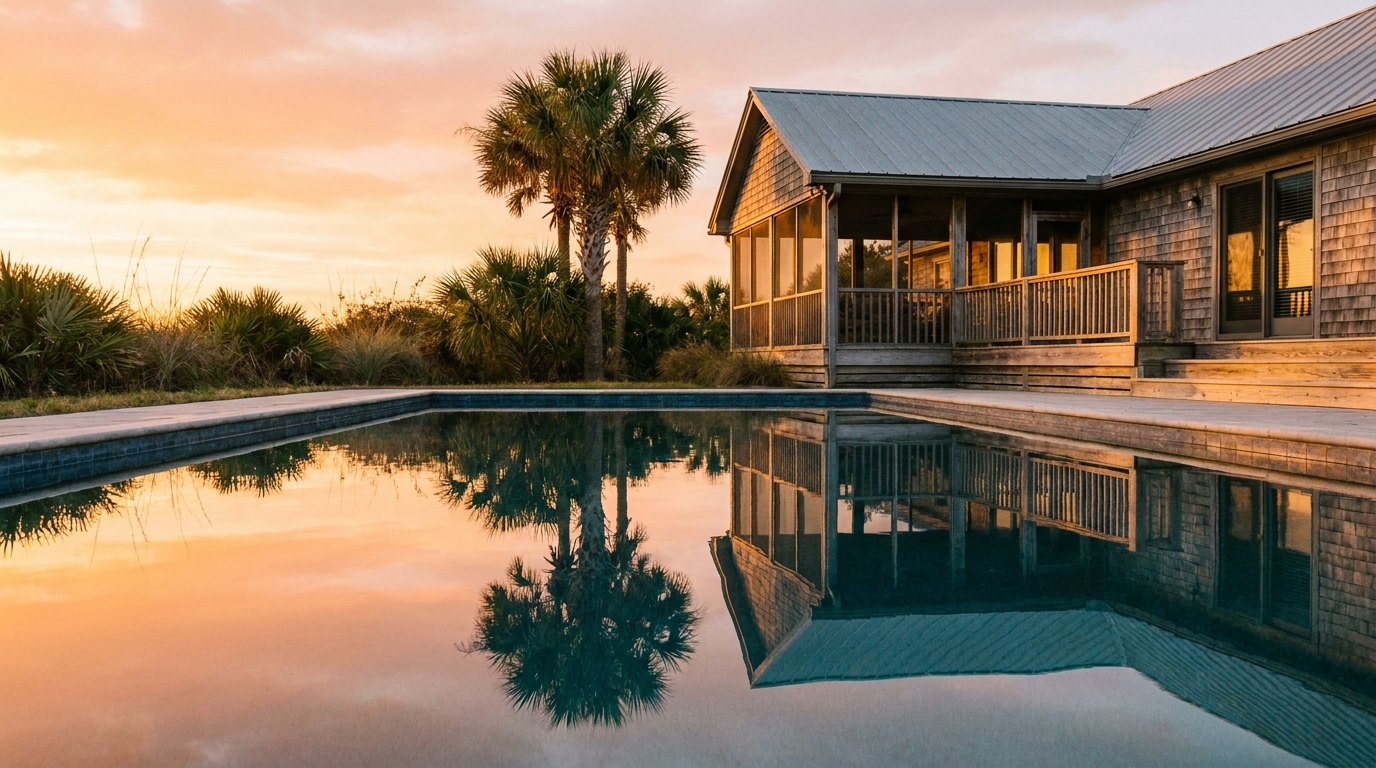
A pool, a hot tub, or a trampoline on a Carolina lot is usually a question for the liability section of a homeowners policy, not a separate product. For swimming pool liability homeowners Carolinas already carry, the practical split is personal liability when someone in the household is legally responsible, and a smaller guest medical payment that can apply even when negligence is not the finding. A fence, a locking cover, a diving board, or a trampoline can change eligibility or price, but that result belongs on the declarations, not in one rule shared by every policy in North Carolina and South Carolina. [1][2][4]
How the liability section is split
North Carolina's Department of Insurance describes a homeowners policy as two sections. Section I is property coverage, lettered A through D. Section II is liability coverage, lettered E and F. A sketch of that package is on the homeowners coverage page, and personal policies as a group are outlined on the personal coverage page. [2]
Coverage E, personal liability, applies when you or a resident of the household is legally responsible for causing injury. The department says this section provides a defense and pays damages as the company deems appropriate. It does not respond in every situation. An intentional act is one stated exception, and the rest of the exclusions sit in the form. [2]
Coverage F, medical payments, pays reasonable medical expenses for a person accidentally injured on the property. The department's example is a neighbor's child hurt while playing at the house. In some limited cases the same section may also pay if you are involved in an injury away from the house. It does not apply to the named insured or to people who reside in the household, and the department says it is not a substitute for health coverage. Business activity is excluded from this section as well. [2]
The state's FAQ puts the same line in shorter language. If a person is injured on the property, the liability section applies only when you are negligent and that negligence causes the injuries. If you are not negligent, medical payments can still cover incurred medical expenses, up to a limited dollar amount. That smaller section does not pay pain and suffering or lost time. [3]
South Carolina's Department of Insurance uses different labels for the same two ideas. Comprehensive personal liability protects against claims from accidents on property you own or rent. With exceptions such as auto and boating accidents, the department calls it all-purpose liability coverage that follows you. Medical expense coverage is limited to a specific amount per person. It can apply on the premises to a person who is not an insured, and elsewhere when an insured or a family member causes the injury. The department says payment is made regardless of legal liability. [4] On a separate page, it says the liability portion pays both the cost of a defense and court awards, up to the limit in the policy documents, and that no-fault medical coverage does not pay the household's own medical bills. [6] The form decides whether defense costs sit inside that limit.
The National Association of Insurance Commissioners, on a topic page last updated October 25, 2025, says personal liability covers financial losses when the insured is found legally responsible, and that medical payments pay medical bills for people hurt on the property. The policyholder chooses both limits. [1]
The Insurance Information Institute says the insurance industry treats a pool as an attractive nuisance, meaning the feature raises liability risk, and it advises a review when a pool is in place or about to be installed. The Institute's pool article suggests considering at least $300,000 or $500,000 of liability, and more if assets warrant it. [7] That article shows no revision date, and it still sits next to accident figures from 2005 through 2014, so the dollar suggestion is the Institute's published guidance, not a 2026 price survey and not a minimum set by either state insurance department. A personal umbrella sits above home liability and, when purchased, pays beyond the homeowners limit. [1] South Carolina's department says additional liability coverage and additional medical payments coverage can be purchased, and it describes that premium as nominal. [5]
The same swimming pool liability homeowners Carolinas should read on the declarations is not limited to the water. South Carolina says this liability coverage follows you, aside from exceptions such as auto and boating, and North Carolina notes that medical payments may respond, in limited cases, away from the house. [2][4] A paid lesson business, or a rental the form treats as a business, falls under the business exclusion North Carolina states for guest medical payments. [2] A fence does not, on those department pages, create or erase legal responsibility by itself. It can be a building rule and also an underwriting condition.
Fences, gates, and hot tub covers
North Carolina ties residential pools, spas, and hot tubs to the residential code. Johnston County's inspections office, on a page updated May 14, 2026, says its notes come from the current North Carolina Residential Code, Appendix V, and are not a substitute for the code. The summary calls for a barrier 48 inches tall from finished grade, a bottom gap no greater than 2 inches over earth or 4 inches over concrete, and openings that will not pass a 4-inch sphere. Horizontal members less than 45 inches apart go on the pool side, with vertical gaps held to 1.75 inches. Wider spacing of those members allows vertical gaps up to 4 inches. Pedestrian gates must swing away from the pool, close themselves, and latch themselves, with the release at least 54 inches above the bottom of the gate. If a house wall is part of the barrier, a door opening toward the pool needs an alarm listed to UL 2017, with the shutoff 54 inches above the threshold. The county says most home alarm systems do not meet that listing. Above-ground sides at least 48 inches tall may be the barrier if the ladder or steps can be locked, secured, or removed. [9]
Morehead City's summary of the 2018 appendix matches that height, sphere test, and gate direction, and it adds a lower-latch path: below 54 inches, openings near the mechanism must be tighter, and the mechanism sits on the pool side, 3 inches below the top of the gate. Where a dwelling wall is part of the barrier, the city lists a power safety cover complying with ASTM F1346, a UL 2017 door alarm that starts within 7 seconds and stays audible for 30 seconds, or approved self-closing, self-latching doors that protect at least as well. [10]
The two pages do not describe hot tubs the same way. Johnston County says a hot tub or spa may be exempt if the safety cover complies with ASTM F1346. [9] Morehead's excerpt says an outdoor pool, including a hot tub or spa, shall be surrounded by a complying barrier, and it places that cover among the options used when a house wall is part of the barrier. [10] We confirm a lockable cover with the inspections office for that address rather than treating either summary as a waiver. Permit depth is local too. Johnston County requires a permit for in-ground pools, permanently installed above-ground pools, and portable pools with water 24 inches deep or more. A portable pool under 24 inches that is stored when idle does not need a permit there. [9]
South Carolina does not print one barrier height for every residential lot. The Building Codes Council's December 2022 codes-in-effect sheet says mandatory codes, including the 2021 South Carolina Residential Code, must be enforced statewide, with an implementation date of January 1, 2023. The same sheet lists the International Swimming Pool and Spa Code as permissive: a city or county adopts it by ordinance before enforcement begins. [11] The Council's 2024 modifications index, version November 3, 2025, records an adoption on August 26, 2025, sets January 1, 2027 for the next mandatory codes, and again lists the pool and spa code as permissive. [12] The 2018 modification index shows the reason that status has mattered. Modification IRC 2018 19 deletes section R326, on swimming pools, spas, and hot tubs, without a substitute, because the section conflicts with the permissive code. The effective date on that modification is July 1, 2016. [13] A barrier rule on a given lot can come from a local ordinance, from a locally adopted pool and spa code, or from both. We ask the building office which text it enforces.
The U.S. Consumer Product Safety Commission's 2023 booklet, Publication 362, is a national reference and not a mandate. It says the guidelines are not a CPSC standard and are not mandatory, and it directs readers to local law. It recommends a barrier at least 48 inches above grade on the outer side, openings that block a 4-inch sphere, and pedestrian gates that open outward, close themselves, and latch themselves. Spas and hot tubs are included in its definition of a pool for these guidelines. An above-ground wall can serve as the barrier if it is high enough, with the ladder secured, locked, removed, or fenced. When a house wall is one side, the booklet discusses door alarms and a power safety cover meeting ASTM F1346-91. [8] The booklet does not settle a South Carolina permit.
Diving boards, slides, and trampolines
Johnston County's electrical notes, drawn from the National Electrical Code article the county cites, include bonding of rails, ladders, diving boards, and lights, plus ground-fault protection. [9] That is a wiring condition. It is not a statement that a homeowners policy excludes diving boards.
The North Carolina and South Carolina department pages reviewed here do not publish a statewide premium, surcharge, or exclusion for a diving board, a slide, or a trampoline. Those features, like a missing fence, often show up as conditions that can change eligibility or price. Because that pattern is not written as a universal rule on those department pages, the reading that holds is the declarations, plus any endorsement that names the feature. If the declarations are silent, ask for the answer in writing before a board, a slide, or a trampoline is added.
Trampolines are not pools, and pool-barrier rules do not describe them. A 2015 CPSC sheet, Publication 085, also marked 062013, says an enclosure can help prevent injuries from falls off the trampoline. The same sheet says to allow only one person on at a time, to keep pads over the springs, hooks, and frame, and not to use a ladder, because a ladder gives small children a way up without supervision. [14] Those are product-safety steps from 2015, not a current injury count and not a company rule. An enclosure, or the lack of one, can still be an underwriting question. Confirm it on the policy the same way a fence is confirmed.
When the loss is the pool, not a guest
Guest injury and damage to the pool shell are different sections. North Carolina's department says Coverage B protects structures on the residence premises that are not attached to the dwelling, such as a detached garage or a tool shed. That limit is normally 10 percent of Coverage A, and a higher amount can be purchased. [2] A pool, a pool house, or a fence may fall there when the form treats it as a detached structure. An indoor pool, or an in-ground pool the form ties to the dwelling, may be described differently. The declarations classify it. We do not assume every in-ground pool is capped at 10 percent of the house limit.
The Insurance Information Institute says to carry enough protection to replace the pool if a storm destroys it, including deck furniture. [7] Flood is not that storm claim. North Carolina's FAQ states that homeowners policies do not cover flood or rising water. [3] The NAIC page updated in October 2025 lists flood insurance as a separate policy. [1]
If a pool, a fence, or a trampoline is added after the policy is issued, the file has to catch up. North Carolina's department says to update the agent when renovations are made so the change is noted, and it gives fences and storage sheds as examples. [15] The Institute says to review the policy when a pool is present or planned, because liability risk goes up. [7] A hot tub and a trampoline deserve the same notice.
When our team reads a policy for this exposure, we look for the Coverage E limit beside the Institute's $300,000 or $500,000 suggestion, the Coverage F limit, any endorsement that names a pool, a board, a slide, a trampoline, a fence, or a cover, and the property limit that would repair the pool itself. [2][3][7] We also note which building text the local office uses. [9][11] That is the swimming pool liability homeowners Carolinas can actually verify.
Practical takeaways
- Personal liability and guest medical payments do different jobs. One turns on legal responsibility and can include a defense. The smaller one can pay a limited medical bill without that finding, and it does not cover the household or replace health coverage. [2][3][4][6]
- Limits are printed on the declarations. A NAIC page updated October 25, 2025, says the policyholder selects them. The Institute suggests considering at least $300,000 or $500,000 of liability for a pool, on an article that still carries older figures. [1][7]
- North Carolina inspection offices summarize a 48-inch residential barrier, with gate, alarm, and above-ground ladder rules, and they point back to Appendix V. Confirm any ASTM F1346 hot tub exception locally. [9][10]
- South Carolina's Building Codes Council lists the pool and spa code as permissive, including for the 2024 codes set to take effect January 1, 2027. Ask the local office which ordinance applies. [11][12][13]
- A diving board, a slide, or a trampoline is an underwriting question to confirm in writing. The state insurance pages reviewed here do not state one statewide price or exclusion for those features. [9][14]
- Damage to the pool is a property question, often near the detached-structure limit, and flood or rising water is not a standard homeowners claim. [1][2][3][7]
How we can help
Have more questions or want to get in touch? Our team can walk through a declarations page, a fence or cover note, and the limit that applies to a pool, a hot tub, or a trampoline on the contact page.
Citations
- National Association of Insurance Commissioners, "Homeowners Insurance" (2025-10-25)
- North Carolina Department of Insurance, "Basic Homeowners Insurance" (2026)
- North Carolina Department of Insurance, "FAQs About Homeowners Insurance" (2026)
- South Carolina Department of Insurance, "Types of Coverage in a Homeowner's Insurance Policy" (2026)
- South Carolina Department of Insurance, "Additional Homeowner's Insurance Coverages" (2026)
- South Carolina Department of Insurance, "Understanding Basic Homeowners Insurance" (2026)
- Insurance Information Institute, "Pool safety and insurance" (2026)
- U.S. Consumer Product Safety Commission, "Safety Barrier Guidelines for Residential Pools, Publication 362" (2023)
- Johnston County, North Carolina, Building Inspections, "Swimming Pool and Hot Tub Information" (2026-05-14)
- Morehead City, North Carolina, "Swimming Pool Installation & Inspection Guidelines" (2018 code summary)
- South Carolina Building Codes Council, "Building Codes in Effect for South Carolina" (2022-12)
- South Carolina Building Codes Council, "2024 Building Codes Modifications Index" (2025-11-03)
- South Carolina Building Codes Council, "2018 Final Modification Index, IRC 2018 19" (2016-07-01)
- U.S. Consumer Product Safety Commission, "Trampoline Safety, Publication 085" (2015)
- North Carolina Department of Insurance, "Do I Need Homeowners Insurance?" (2026)