utility trailer coverage personal auto Carolinas, NC SC
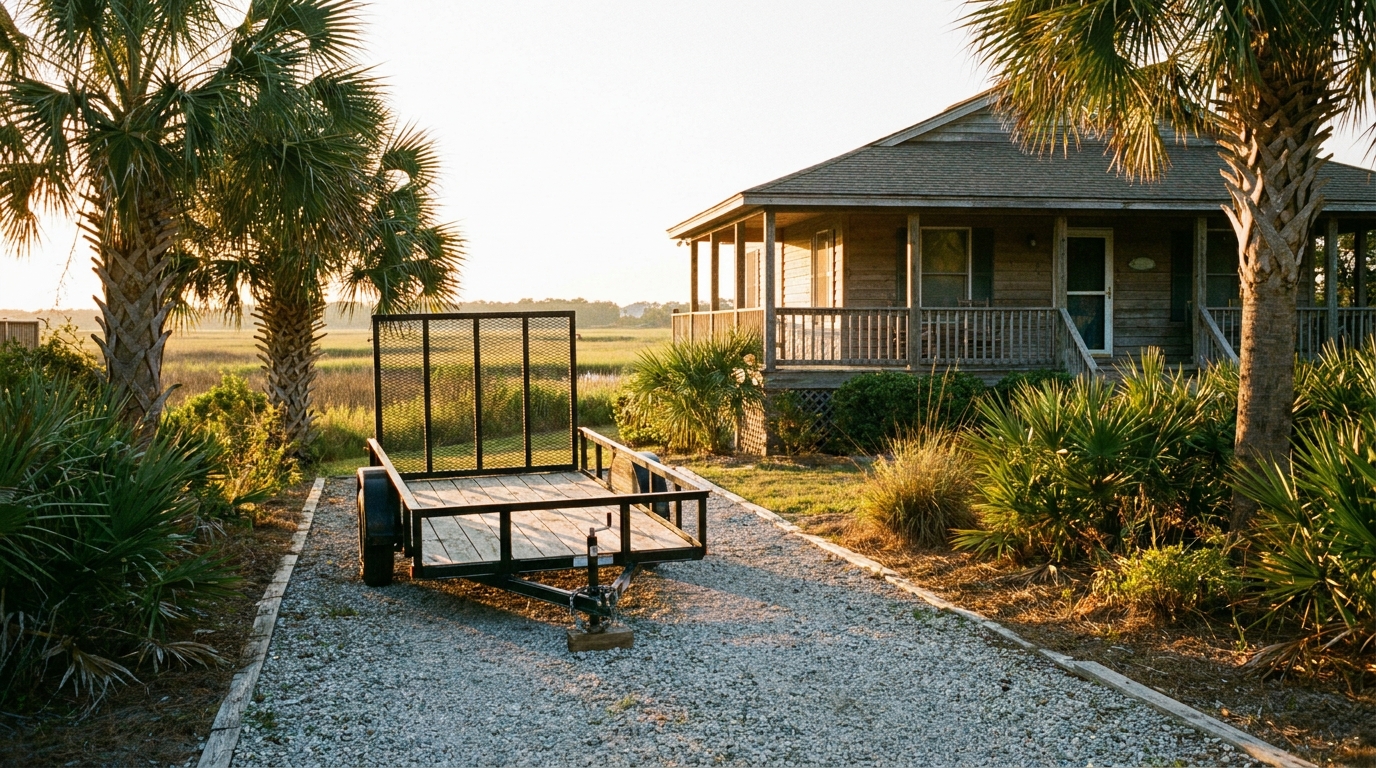
A utility trailer and a cargo trailer raise two insurance questions that should stay separate: whether liability follows the trailer while it is used with a covered auto, and whether collision or comprehensive will repair the trailer itself. Households comparing utility trailer coverage personal auto Carolinas policies can start with the North Carolina Department of Insurance, which describes the personal automobile policy as covering an insured person or a family member while using an automobile or a trailer, and a person using the covered automobile with permission, up to the limits on the policy. [1] That liability grant is not physical damage. The Insurance Information Institute describes property coverage as paying for damage to, or theft of, the car, and it notes that states do not require collision or comprehensive, though a lender may require them on a financed vehicle. [2]
What liability follows while the trailer is in use
Liability coverage pays when a covered person is legally responsible for bodily injury, or for damage to property belonging to someone who is not the insured. [1] [2] The North Carolina department says the personal automobile policy covers the insured or a family member while using any automobile or trailer, up to the split limits on the declarations. [1] The department's example of 100/300/50 is a way to read a per-person bodily injury limit, a per-accident bodily injury limit, and a property damage limit. [1] It is not the legal floor in either Carolina.
South Carolina sets its floor in statute. An automobile policy issued or delivered on a motor vehicle principally garaged or principally used in the state must insure against liability from the ownership, maintenance, or use of those motor vehicles, within the United States or Canada. [3] The minimums are $25,000 for bodily injury to one person in one accident, $50,000 for bodily injury to two or more people in one accident, and $25,000 for property damage in one accident [3]. The South Carolina Department of Insurance states the same limits and states that uninsured motorist coverage is required with liability. [4] The department's FAQ says uninsured motorist coverage has a $200 deductible [4]. The insurance code allows a policy to exclude the first $200 of uninsured motorist property damage, which itself must be at least $25,000 [3]. If a judgment or settlement exceeds the policy limits, the person who is sued can be left to pay the difference. [4]
In that chapter, a motor vehicle includes trailers and semitrailers designed for use with a self-propelled highway vehicle, and the exceptions include farm trailers. [3] A utility or cargo trailer built to be pulled on the highway sits inside that definition in a way a farm trailer does not. South Carolina does not publish North Carolina's sentence about use of any trailer, so read the form on its own. Liability may follow a trailer while it is attached to a covered auto, and the grant may be broader or narrower than "attached." We read the exclusions before treating a parked trailer as a trailer in tow.
North Carolina's minimums moved on July 1, 2025. Policies issued or renewed before that date sat at $30,000 per person and $60,000 per accident for bodily injury and $25,000 for property damage [5]. Policies issued or renewed on or after that date must provide $50,000, $100,000, and $50,000 [5]. The Division of Motor Vehicles publishes the same amounts, using "before July 1, 2025" and "after July 1, 2025" as the two columns. [6] The liability-policy statute now states the $50,000, $100,000, and $50,000 limits [7]. Underinsured motorist coverage is included on policies issued or renewed on or after July 1, 2025. [5] The personal automobile policy pays up to the limits listed on it. [1]
When physical damage on the trailer has to be added
If a weight cutoff, a dollar cap, or a scheduling rule is not printed on the form, the form controls it. That gap is the practical core of utility trailer coverage personal auto Carolinas decisions.
Collision pays for damage to the policyholder's car from a collision with a vehicle or an object, or from flipping over. Comprehensive pays for theft and for damage the Institute describes as different from that collision, including fire, falling objects, hail, flood, vandalism, and contact with an animal. [2]
North Carolina draws the damage section more tightly than the liability section. It applies to direct and accidental loss to the covered automobile, or to a non-owned automobile that meets a stated definition: a private passenger automobile or trailer not owned by the insured or a family member, and not furnished or available for regular use, while in that person's custody or being operated by that person. A non-owned auto or trailer used as a temporary substitute, because the covered auto is out for breakdown, repair, servicing, loss, or destruction, is in that section too. [1] An owned utility trailer is not a non-owned trailer. Collision or comprehensive on the box itself has to come from the declarations, a schedule, or an endorsement. The form controls the deductible, the valuation, and any dollar cap.
A trailer that is not owned, and not available for regular use, may have damage coverage while it is in custody. [1] A trailer kept at the house and used as a matter of course is a poor fit for that sentence. The department also lists a miscellaneous type vehicle endorsement for motorcycles, golf carts, travel trailers, and similar vehicles. [1] A plain utility or cargo trailer is not that list. The auto coverage pages and the personal policies pages show how a household policy is built.
Cargo is a third question. Collision and comprehensive, as the Institute describes them, pay for the car. [2] The department's damage section is about the covered automobile and a non-owned trailer that meets the definition, not about tools or furniture in the load. [1] Whether that load is inside the form is a declarations question.
South Carolina plates, the exemption, and the insurance certificate
Every motor vehicle, trailer, semitrailer, and pole trailer driven on a South Carolina highway is to be registered and licensed, and moving one that is required to be registered, while it is unregistered, is a misdemeanor. [8] Section 56-3-130 is the exemption for a private utility trailer. Boat trailers under 2,500 pounds, farm trailers, and utility trailers owned by a private person and not for hire need not be licensed or registered. [8]
The Department of Motor Vehicles states a more operational version. A utility, pole, or farm trailer must be registered only if the owner is traveling out of South Carolina. A boat trailer with an empty weight of 2,500 pounds or more must be registered for South Carolina roads or for travel out of state. A boat or utility trailer under an empty weight of 2,500 pounds does not need registration if the owner is not leaving the state. [9] That page lists a utility permanent plate at $75 that cannot be transferred and does not require a property tax receipt, and a utility trailer plate at $10 that can be transferred to a trailer the same owner has, again with no property tax receipt [9]. The code states a $75 permanent-plate fee for a utility trailer and states that the license is not transferable [8].
The statute and the public page are not one sentence. Read section 56-3-130 beside the live DMV page. An owner who will cross a state line should treat registration as required under that page [8] [9].
The plate is what turns on the security duty. If the motor vehicle is required to be registered, the owner must keep the required security for the whole registration period, and the applicant must declare that the vehicle is insured and will stay insured [10]. That security includes at least the $25,000, $50,000, and $25,000 liability floor [3] [10]. An unplated private utility trailer, where the exemption allows it, is not in the same posture as a plated trailer. Towing it still raises a liability question on the tow vehicle's policy. It does not, by itself, put the owner under the registration security duty. Once the plate is on, that duty runs for the registration period [8] [10].
The DMV also says a driver may need a Class E or Class F license if gross vehicle weight is 26,001 pounds or more. [9] That is a license fact for a heavy combination, not a coverage trigger inside a personal auto form.
North Carolina title, registration, and continuous liability
A motor vehicle in North Carolina is every self-propelled vehicle and every vehicle designed to run upon the highways and pulled by a self-propelled vehicle. Mopeds and electric assisted bicycles are set aside unless a specific provision includes them. [11] A vehicle intended to be operated on a highway must be registered before it is operated. [12] The Division of Motor Vehicles says a trailer should be titled and registered in a similar manner as a car. Someone moving from a state that does not title and register trailers is sent to the State Highway Patrol investigative unit. [13]
Section 20-51 exempts certain farm trailers and semitrailers used by a farmer, tenant, agent, or employee while moving farm products, supplies, or equipment in the ways the section describes, and certain small tobacco-handling trailers. [14] A household cargo trailer is not given a general exemption there. The working assumption on a public highway is that a personal cargo trailer is titled and registered. [12] [13] [14]
No motor vehicle may be registered unless the owner proves financial responsibility and keeps it for the whole registration period. [15] All vehicles with a valid North Carolina registration must have continuous liability insurance from a company licensed in North Carolina. Out-of-state policies are not accepted. [6] Cancel the policy only after the plate is turned in. Effective October 1, 2026, the registered owner has 30 days from the date on a termination notice to respond. [6] A North Carolina plate puts the trailer in that system. A trailer left unregistered in South Carolina under the private exemption is not, by that fact alone, a North Carolina registered vehicle. [6] [10] [15]
Borrowed trailers, cargo, and hauling for pay
Borrowed use is where utility trailer coverage personal auto Carolinas assumptions fail. North Carolina's description extends liability to use of a trailer, and it may extend damage coverage to a non-owned trailer that is not available for regular use, while that trailer is in custody. [1] Permission from the trailer owner does not rewrite exclusions. A rental-lot trailer can be a transaction the personal auto form was not priced to cover. If the rental contract and the auto form are both silent on a number, do not invent one.
Hauling for pay changes the South Carolina picture. Section 56-3-130 reaches a utility trailer a private person owns and does not hold out for hire. [8] A business must register a semitrailer or a pole, utility, or boat trailer to use it on South Carolina roads or out of state. [9] Do not assume a personal auto policy answers a paid haul or a job-site box. If the use is the occupation, read the exclusions. [1] Liability, as those pages describe it, can answer for harm such as a damaged fence. Collision answers for the car. [1] [2] Cargo on the trailer is a separate question the form has to answer. Keep the bill of sale. [13]
Reading the two states side by side
Read as three columns, and utility trailer coverage personal auto Carolinas stops being a slogan. Liability follows use of a trailer in the North Carolina description, and South Carolina's floor is $25,000, $50,000, and $25,000, with trailers inside the motor vehicle definition except farm trailers [1] [3]. Physical damage on an owned trailer has to be scheduled or endorsed. A missing line on the declarations is not a promise to repair the box. [1] [2] South Carolina can leave a private, not-for-hire utility trailer unregistered for in-state use, while the DMV page treats an individual's out-of-state trip as the point when registration is required. North Carolina ties a valid registration to continuous liability insurance from a company licensed in that state [6] [8] [9] [15].
Practical takeaways
- Liability can follow use of a trailer. Collision and comprehensive follow the vehicles the damage section describes. [1] [2]
- In North Carolina, schedule or endorse an owned utility or cargo trailer if the box itself should be repaired or replaced. The non-owned trailer sentence does not do that job. [1]
- In South Carolina, section 56-3-130 says a utility trailer owned by a private person and not for hire need not be registered. The DMV page treats an individual's out-of-state trip as requiring registration [8] [9].
- A South Carolina registration requires the owner to keep the required security for the whole registration period and to declare that the vehicle is insured and will stay insured [10].
- A North Carolina plate needs continuous liability insurance from a company licensed in North Carolina. Out-of-state policies are not accepted. Policies issued or renewed on or after July 1, 2025 use limits of $50,000, $100,000, and $50,000 [5] [6].
- Do not guess a dollar cap, a policy weight cutoff, or a cargo limit. Paid hauling belongs in the exclusions. [1] [8]
How we can help
Have more questions or want to get in touch? Our team can walk through the declarations, the trailer description, and the plate papers and show what the form actually says, on the contact page.
Citations
- North Carolina Department of Insurance, "Basic and Miscellaneous Auto Coverages" (2026)
- Insurance Information Institute, "Auto Insurance Basics" (2026)
- South Carolina Legislature, "Title 38, Chapter 77, Automobile Insurance" (2026)
- South Carolina Department of Insurance, "FAQs: Auto Insurance" (2026)
- North Carolina Department of Insurance, "Changes to the Rating of Automobile Insurance Policies, Effective July 1, 2025" (2025)
- N.C. Division of Motor Vehicles, "Vehicle Insurance Requirements" (2026-09-09)
- North Carolina General Assembly, "G.S. 20-279.21, Motor vehicle liability policy defined" (2026)
- South Carolina Legislature, "Title 56, Chapter 3, Motor Vehicle Registration and Licensing" (2026)
- South Carolina Department of Motor Vehicles, "Camper, Trailer, or RV" (2026)
- South Carolina Legislature, "Title 56, Chapter 10, Motor Vehicle Registration and Financial Security" (2026)
- North Carolina General Assembly, "G.S. 20-4.01, Definitions" (2026)
- North Carolina General Assembly, "G.S. 20-50, Owner to secure registration and certificate of title" (2026)
- N.C. Division of Motor Vehicles, "Trailers and semi-trailers to title and register" (2026-05-18)
- North Carolina General Assembly, "G.S. 20-51, Exempt from registration" (2026)
- North Carolina General Assembly, "G.S. 20-309, Financial responsibility prerequisite to registration" (2026)